

Aug 13, 2026
Benjamin Brown
For most people living with chronic migraine, glucose metabolism and diet are not part of the conversation in clinical management. Yet a new study suggests that metabolic asessment is important and may point towards biological features that could help personalise care. The research suggests that in chronic migraine, it may not simply be low or high blood sugar that matters, but instability itself, and that this could offer insights into treatment.
The study, led by researchers at Noorda College of Osteopathic Medicine including Dr Kyle Bills, examined whether people with chronic migraine handle glucose—the body’s principal fuel—differently from people without migraine. Their answer is cautiously provocative. Across glucose-tolerance tests and continuous glucose-monitoring data, the migraine group showed more erratic glucose patterns, particularly around meals. The implication is not that migraine is diabetes in disguise. Rather, the authors propose that for some people, fluctuating fuel availability may help make an already sensitive brain more vulnerable to attacks.
Study highlights:
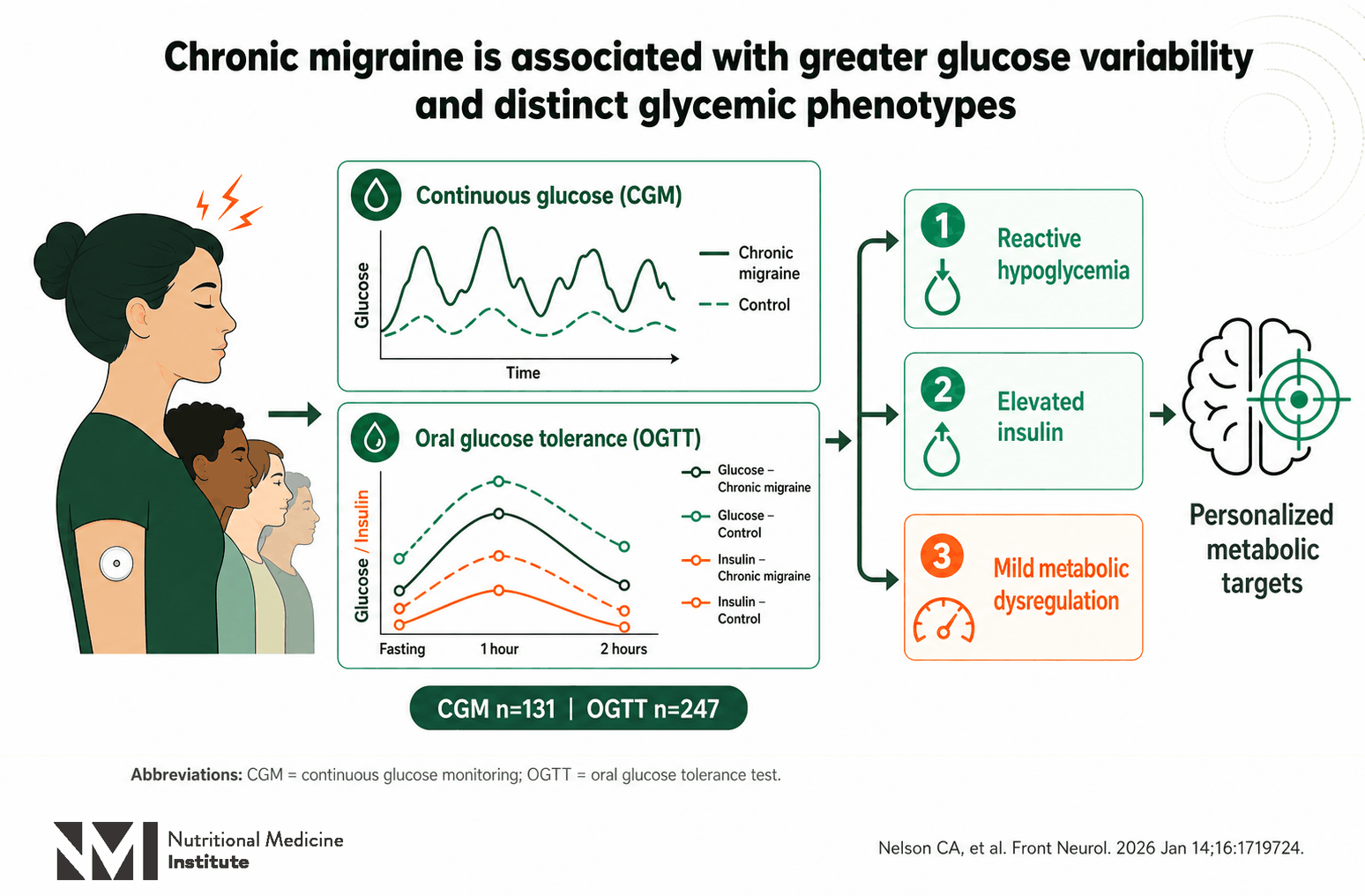
- Chronic migraine was associated with greater glucose instability: Particularly after meals, people with chronic migraine experienced larger post-meal glucose excursions and more pronounced dips below pre-meal glucose levels than matched controls.
- The findings support a neuroenergetic model of migraine: Fluctuations in glucose availability—rather than simply low or high blood glucose—may increase the susceptibility of an already sensitive brain to migraine attacks.
- Distinct metabolic phenotypes were identified: Within the chronic migraine cohort, these included patterns consistent with reactive hypoglycaemia, insulin resistance, and a subgroup with fewer metabolic abnormalities but more depression and sleep disorders, highlighting the biological heterogeneity of chronic migraine.
That idea fits a growing “neuroenergetic” view of migraine. The brain is a remarkably energy-hungry organ. If its supply of usable fuel does not match its needs, even briefly, the resulting mismatch could affect the neural systems involved in pain, appetite, autonomic control and sensory sensitivity. Fasting and missed meals have long been recognised migraine triggers; this research asks whether the problem might also arise after eating.
The team analysed oral glucose-tolerance tests from 247 people with chronic migraine, comparing them with a carefully matched normative dataset. The migraine group had lower average glucose levels both while fasting and two hours after consuming a glucose drink. In a smaller subset for whom insulin data were available, fasting and three-hour insulin concentrations were higher than generally accepted reference values.
They also studied continuous glucose-monitoring data from 131 people with chronic migraine and 24 matched controls. Here the signal was less about a single reading and more about the shape of the day. During waking hours, the migraine group had higher average glucose values and greater within-day and day-to-day variability. Their readings also showed greater movement into ranges considered potentially risky at either end of the glucose spectrum.
The most striking finding came after meals. Compared with controls, people with chronic migraine experienced larger glucose excursions—higher peaks and, importantly, more substantial or prolonged dips below their pre-meal baseline. The measure used to capture those post-meal dips was 44% greater in the migraine group. In plain terms: after eating, their glucose traces appeared more like a rollercoaster than a gently rolling road.
That does not prove that glucose swings cause migraine. The study was mainly retrospective, and the control groups were relatively small or drawn from existing datasets. It also did not track headache severity or the timing of attacks alongside each glucose change. Those limitations matter: people with severe migraine may eat, sleep, exercise or take medicines differently, all of which could influence glucose regulation. The researchers are clear that their findings should be treated as preliminary.
Still, the work becomes more intriguing when it looks beyond averages. Using a statistical clustering method, the authors identified three distinct glucose-and-insulin response patterns among 64 migraine participants. One group appeared to show reactive hypoglycaemia: relatively high fasting insulin followed by a pronounced glucose fall after a glucose load. A second showed broadly normal glucose responses but consistently higher insulin, suggesting a more insulin-resistant pattern. The third had fewer obvious metabolic abnormalities, but more reported depression and sleep disorders.
These clusters are an early attempt at something migraine care badly needs: recognising that chronic migraine may not be one condition with one biological driver. The authors observed different treatment patterns across the groups—triptans appeared more useful in the reactive-hypoglycaemia cluster, while CGRP-targeting medicines were more common in the insulin-resistant group—but these observations are exploratory, not evidence that a glucose test can currently prescribe the right drug.
The researchers suggest that a post-meal glucose dip could send the hypothalamus—the brain’s energy and homeostasis hub—a misleading “fuel shortage” signal. This may disrupt the balance of sympathetic and parasympathetic activity, activate pathways connected with the trigeminal pain system, and lower the threshold for cortical spreading depression, a wave of altered brain activity closely linked to migraine aura and attacks. Repeated over time, they suggest, such cycles could help sustain chronic migraine.
It is an elegant hypothesis, but it remains a hypothesis. The lasting value of this paper may be less in offering an immediate dietary prescription than in reframing a question. Rather than asking whether migraineurs have “bad blood sugar,” researchers may need to ask how the body and brain respond to changing energy availability—and whether that response differs from one patient to another.
The study gives scientific weight to a lived experience many patients already recognise: the timing and composition of meals can sometimes matter. The next step is larger, prospective research that investigates targeted dietary interventions, glucose patterns and migraine symptoms together. If the connection holds up, chronic migraine care may eventually become a more personalised—less about suppressing pain after the alarm sounds, and more about understanding why some brains are so ready to ring it.