What is Functional Medicine?
Functional medicine is a patient-centred, systems-biology-informed approach to clinical care. It aims to identify and address modifiable biological, behavioural, environmental and social contributors to impaired function and disease, while applying conventional diagnosis, risk stratification and treatment appropriately.
Rather than treating a diagnosis as a complete explanation of illness, it asks how symptoms, disease processes, exposures, health behaviours and lived context interact over time. Its intended outcomes are improved function, health-related quality of life and disease control—not the rejection of evidence-based conventional medicine.1–3


Chronic Disease Focus
The model is especially relevant to complex chronic conditions, in which multimorbidity, variable response to treatment and lifestyle-related drivers are common. Functional medicine frames disease as an expression of altered function within interconnected physiological systems.
Thus, hypertension, insulin resistance, depression, gastrointestinal symptoms, chronic pain and fatigue may coexist not merely as separate diagnoses but as overlapping manifestations of sleep disruption, dietary pattern, physical inactivity, psychosocial stress, adiposity, inflammation, medication effects or adverse social conditions.
This framing does not imply that every disease has a single, discoverable “root cause,” nor that disease can necessarily be reversed. It is a clinical hypothesis: identify plausible, actionable drivers; intervene proportionately; and monitor outcomes.4,5

Systems Biology in Practice
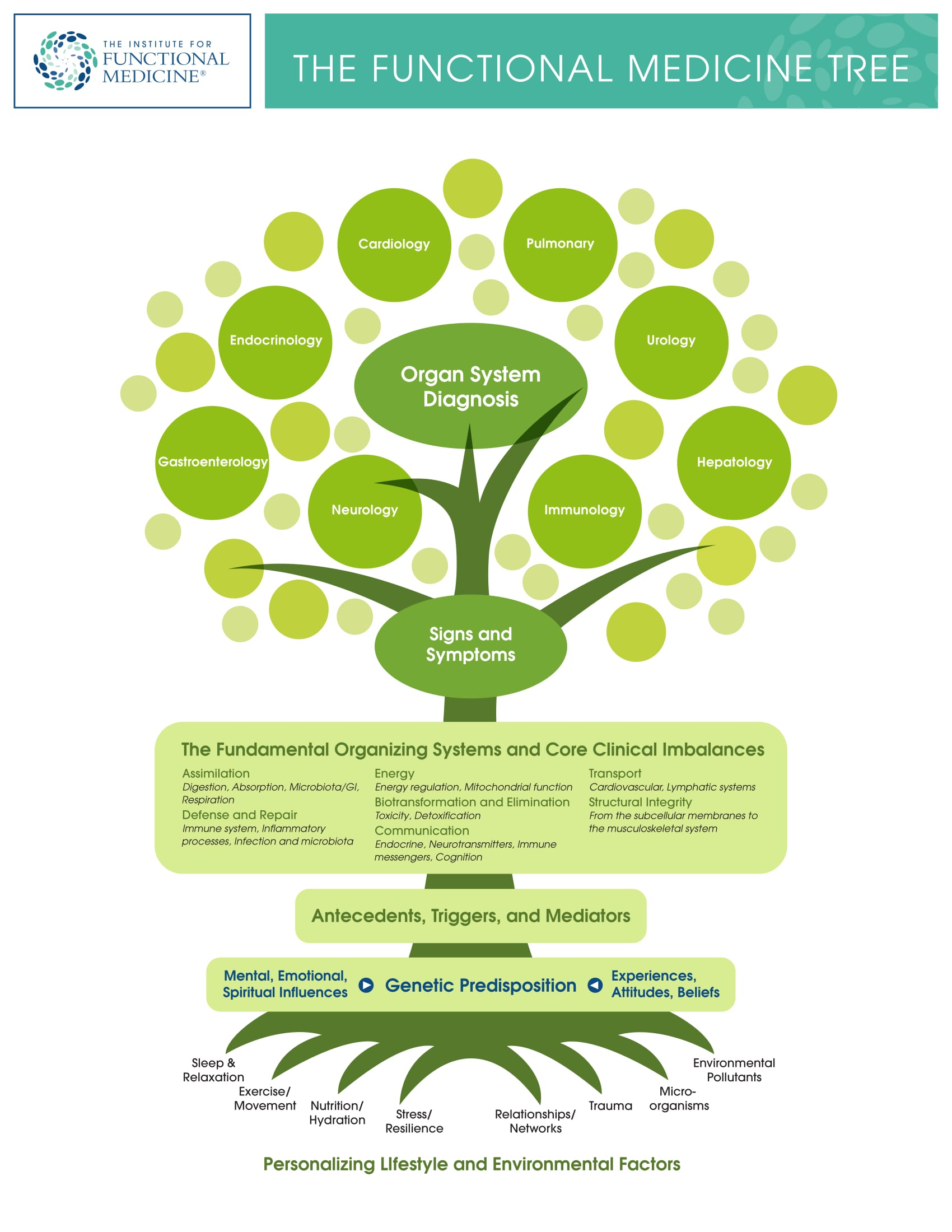
Functional medicine is the clinical application of systems biology to the individual patient. Systems biology recognises that biological pathways operate as interacting networks rather than isolated organ systems. Functional medicine translates that perspective into an assessment of antecedents, triggers and mediators of illness.
Antecedents include inherited susceptibility and early-life exposures; triggers are events that precede deterioration; mediators are factors that perpetuate dysfunction.
The approach considers genetic predisposition alongside diet, nutrient adequacy, sleep, movement, substance use, environmental exposures, psychological wellbeing, relationships and socioeconomic conditions.
It therefore aligns naturally with nutrition practice: food is assessed not as a generic adjunct but as a principal exposure that can influence cardiometabolic risk, gut function, inflammatory pathways, body composition, energy balance and daily functioning.5,6
We are an International Organisational Member of the Institute for Functional Medicine (IFM).
How Functional Medicine Transforms Patient Care
Clinical Assessment
The Institute for Functional Medicine (IFM) describes functional medicine as restoring healthy function by identifying and addressing the processes underlying imbalance and disease in each person.1
Operationally, this begins with a detailed illness narrative and timeline, conventional medical history and examination, review of prior records and medicines, and assessment of health behaviours and social determinants.
The clinician then develops a problem representation that links symptoms and diagnoses to relevant physiological domains—for example, gastrointestinal function, defence and repair, energy metabolism, biotransformation, endocrine-immune signalling, cardiometabolic physiology and structural integrity.
These domains are commonly organised through the Functional Medicine Matrix, a framework intended to connect mechanistic science with patient-specific clinical decisions.4,5

Personalised, Not Unvalidated, Care
Personalisation is central, but it should not be confused with idiosyncratic or unvalidated care. The personalised element is the selection, sequencing and intensity of interventions according to the patient’s risks, goals, preferences, resources, cultural context and readiness for change.
A patient with type 2 diabetes, for example, may require standard pharmacotherapy and cardiovascular risk management alongside nutrition therapy, sleep assessment, physical-activity support, medication review, treatment of depression, food-security intervention and structured follow-up. These are not competing approaches: they are components of one coherent care plan.
Nutritionists may lead dietary assessment and medical nutrition therapy within their professional scope; physicians remain responsible for diagnosis, prescribing, exclusion of serious pathology and appropriate specialist referral.


Therapeutic Hierarchy
The therapeutic hierarchy generally begins with foundations: a nutrient-dense dietary pattern appropriate to the individual; adequate sleep; regular movement; tobacco and alcohol risk reduction; stress-management strategies; social connection; and treatment of practical barriers such as financial insecurity or limited food access.
Targeted interventions may then include condition-specific dietary modifications, behavioural coaching, evidence-based supplements, pharmaceuticals, rehabilitation and referral to allied health or specialist care.
Food-is-medicine practice treats dietary pattern, culinary skills, access and social context as therapeutic variables, while avoiding reduction of nutrition to isolated nutrients or commercially driven testing.7,8
The objective is not perfect adherence to an idealised protocol; it is a feasible plan that meaningfully improves health and function.
As an Organisational Partner of IFM, we offer our members programme discounts including 40% off Applying Functional Medicine in Clinical Practice (AFMCP) and 40% off Advanced Practice Modules (APMs).

Health Equity and Feasibility
Functional-medicine assessment gives explicit weight to health equity. Social determinants—including housing, education, income, transport, food access, racism, work demands and health literacy—can shape exposure, treatment feasibility and outcomes. Asking a patient to purchase specialised foods, supplements or tests without examining affordability, cultural relevance and access can widen inequity.
Accordingly, a credible plan must incorporate social context, shared decision-making and referral to community resources where available. It should distinguish what is clinically desirable from what is practicable, and measure progress with outcomes meaningful to the patient.9
Therapeutic Partnership
The clinician–patient relationship is an active therapeutic component. Functional medicine prioritises deep listening, shared formulation, motivational interviewing and iterative follow-up. This is not simply a longer consultation; it is a structured partnership in which the patient’s narrative, values and capacity for change inform the plan.
Functional outcomes–energy, pain interference, physical function, mood, sleep, participation and quality of life–are monitored alongside conventional biomarkers and disease-specific measures. This emphasis on patient-reported outcomes is consistent with published evaluations of the model.6,10
“The science behind chronic illness calls for a focus not on the average but on the individual. Precisely because everyone of us in, in fact, unique, an operating model that treats us as average can’t possibly be effective.”
Dr Jeffrey Bland PhD
Evidence in an Emerging Discipline
Functional medicine draws on established evidence, including nutrition science, lifestyle medicine, pharmacotherapy, behavioural interventions, environmental medicine and management of social risk. Evidence for functional medicine as an integrated model of care is emerging but is not definitive across diseases and settings; evidence-based practice requires integration of best available research, clinical judgement and patient values.3
In a retrospective matched-cohort study, functional-medicine care was associated with greater improvement in patient-reported global physical health than usual primary care at six months.10

We award a scholarship programme designed to support certification in functional medicine for applicants that demonstrate a passion and commitment to improving healthcare in their workplace and community. The scholarship features $10,000.00 in funds to be used for IFM training programmes.
The Institute for Functional Medicine

The Institute for Functional Medicine is a non-profit educational organisation that has defined and disseminated this model for over 30-years. Its education includes introductory and advanced training in systems-based assessment, nutrition and lifestyle interventions, clinical tools and case-based application; its independent certification pathway leads to the Functional Medicine Certified Practitioner credential.1
For physicians and nutrition professionals, the practical benefit is structured training in a shared clinical language and repeatable workflow: taking a functional timeline, organising complex data, prioritising interventions, collaborating across disciplines and evaluating outcomes. Certification signals assessed competence in the framework and commitment to continuing professional development; it does not replace a professional licence, specialty training, credentialing requirements or the obligation to practise within scope.
Functional Medicine and the Future of Healthcare
Functional medicine is best understood as a person-specific model for managing clinical complexity. It complements conventional care by integrating physiology, nutrition, behaviour, environment and social context into a longitudinal clinical formulation. Its value lies in making drivers of health and disease more visible, actionable and measurable.
Practised responsibly, it uses the best available evidence, respects disciplinary boundaries, prioritises foundational lifestyle and nutrition care, and maintains the safety, diagnostic vigilance and outcome measurement expected in all clinical medicine.

As a select International Organisational Member of IFM, the Nutritional Medicine Institute (NMI) support the global development of functional medicine.
To learn more about what we do and how our partnership can benefit you, visit our membership and events.
References
- Institute for Functional Medicine. [What Is Functional Medicine?](https://www.ifm.org/functional-medicine). Accessed 24-July 2026.
- Bland JS. Functional medicine past, present, and future. Integr Med (Encinitas). 2022;21(2):22-26.
- Bland JS. What is evidence-based functional medicine in the 21st century? Integr Med (Encinitas). 2019;18(3):14-18.
- Hanaway P. Form follows function: a functional medicine overview. Perm J. 2016;20(4):16-109.
- Bland JS. Systems biology meets functional medicine. Integr Med (Encinitas). 2019;18(5):14-18.
- Bland J. Defining function in the functional medicine model. Integr Med (Encinitas). 2017;16(1):22-25.
- Hyman M, Bradley E. Food, medicine, and function: food is medicine part 1. Phys Med Rehabil Clin N Am. 2022;33(3):553-570.
- Hyman M, Bradley E. Food, medicine, and function: food is medicine part 2. Phys Med Rehabil Clin N Am. 2022;33(3):571-586.
- Bharmal N. Social determinants and health equity in functional medicine. Phys Med Rehabil Clin N Am. 2022;33(3):665-678.
- Beidelschies M, Alejandro-Rodriguez M, Ji X, et al. Association of the functional medicine model of care with patient-reported health-related quality-of-life outcomes. JAMA Netw Open. 2019;2(10):e1914017.