

Oct 1, 2026
Benjamin Brown
A new case–control study strengthens the emerging link between thiamine (vitamin B1) deficiency and chronic migraine. When considered alongside recent intervention studies, the findings suggest that nutritional status may represent an overlooked, modifiable factor in selected patients.
Study highlights:
- Patients with chronic migraine had significantly lower serum thiamine concentrations than matched healthy controls.
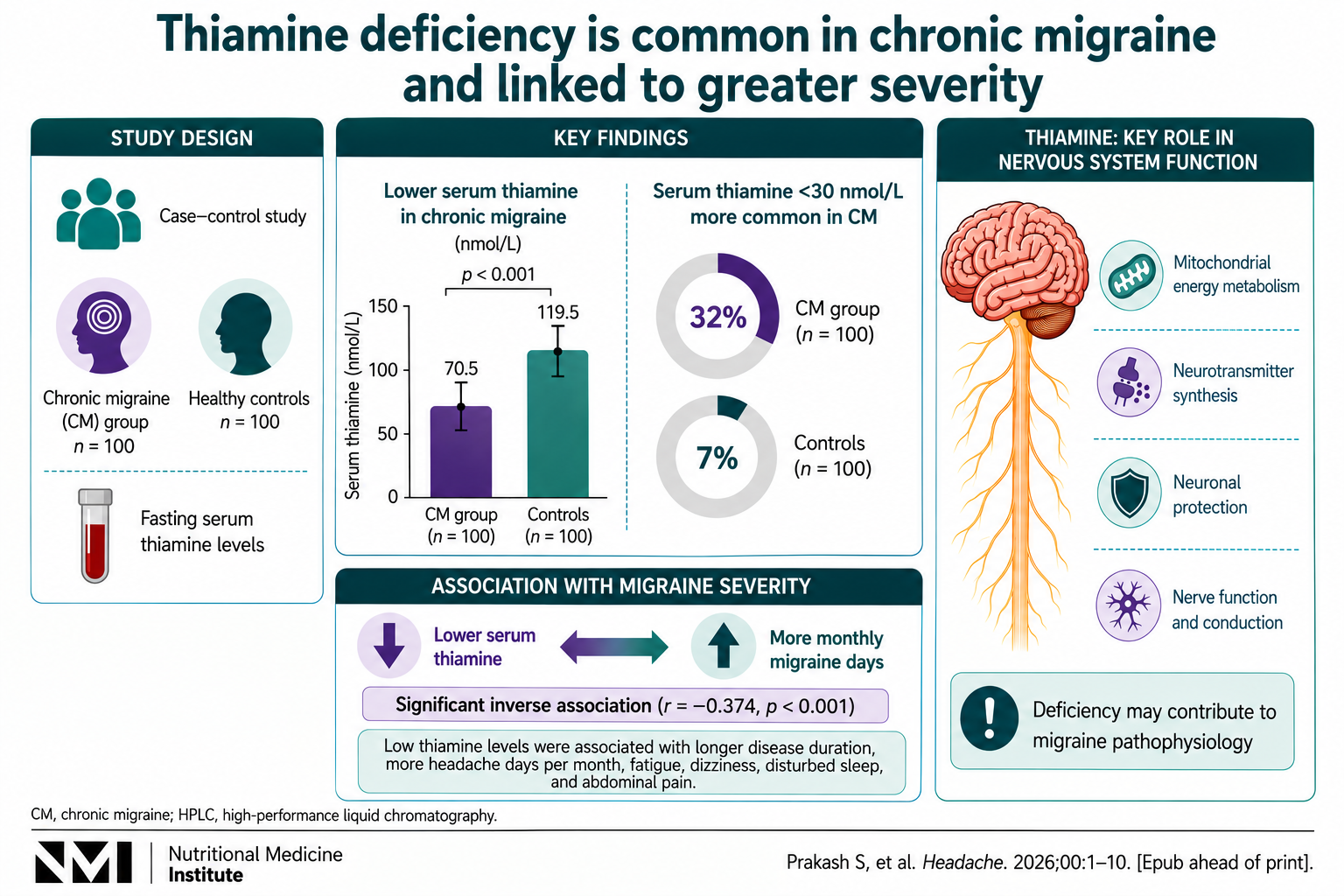
- Serum thiamine levels below 30 nmol/L were independently associated with almost five-fold higher odds of chronic migraine.
- Lower thiamine status was linked with more headache days, longer disease duration and greater fatigue, dizziness, disturbed sleep and abdominal pain.
- Emerging clinical evidence suggests thiamine supplementation may improve migraine outcomes, but larger trials are required before routine implementation.
For clinicians managing chronic migraine nutritional status is rarely considered. However, a case–control study by Prakash et al. (2026) raises an important question: could vitamin B1 deficiency contribute to migraine burden in a subset of patients? The investigators compared 100 adults with chronic migraine with 100 age- and sex-matched healthy controls and found markedly lower serum thiamine concentrations in the migraine group (52.4 vs. 83.8 nmol/L).1 Nearly one-third of patients with chronic migraine had serum levels below 30 nmol/L, and after adjustment for demographic and lifestyle factors, low thiamine remained independently associated with chronic migraine.
Beyond the statistical association, the study offers clinically relevant observations. Patients with lower thiamine levels experienced more headache days each month, longer disease duration, and substantially higher rates of fatigue, dizziness, disturbed sleep and abdominal pain. These symptoms are familiar to clinicians treating chronic migraine and are often attributed solely to the underlying disorder. The findings raise the possibility that, in some patients, they may also reflect an accompanying micronutrient deficiency worthy of investigation.
The biological rationale is equally compelling. Migraine is increasingly viewed as a disorder of cerebral energy metabolism, with mitochondrial dysfunction implicated in chronification. As an essential cofactor in glucose metabolism and ATP production, thiamine deficiency could reduce neuronal energy availability, increase oxidative stress and lower the threshold for cortical dysfunction. The authors also propose a bidirectional relationship in which recurrent nausea, vomiting and reduced appetite during migraine attacks contribute to thiamine depletion, which may in turn exacerbate headache burden. This hypothesis provides a plausible mechanistic framework linking nutritional status with migraine progression.
The association becomes more clinically meaningful when viewed alongside previous intervention studies. In a randomised, double-blind, placebo-controlled trial, Ghods et al. (2024) demonstrated that high-dose thiamine supplementation over 12 weeks significantly reduced migraine frequency, duration, pain intensity and migraine-related disability in women with episodic migraine compared with placebo.2 Although conducted in episodic rather than chronic migraine, the study provides the strongest evidence to date that correcting thiamine status may improve clinical outcomes. Earlier, Prakash et al. (2016) reported two patients with refractory chronic migraine and biochemical thiamine deficiency whose headaches improved substantially following intravenous thiamine, together with resolution of subtle neurological features consistent with early thiamine deficiency.3 Collectively, these studies extend the current findings beyond association, suggesting that thiamine may represent a clinically relevant therapeutic target that now merits rigorous evaluation in larger chronic migraine trials.
Importantly, the present study cannot establish causality. Its observational design, reliance on serum rather than intracellular thiamine measurements, limited dietary assessment and study population restrict the conclusions that can be drawn and limit generalisability. Nevertheless, this growing body of evidence suggests clinicians should think more broadly about nutritional status in patients with chronic migraine, particularly those with persistent nausea, poor appetite, fatigue or other features suggestive of micronutrient depletion. While routine thiamine supplementation is premature, assessment of vitamin B1 status may prove valuable in selected patients, and future prospective trials will determine whether correcting deficiency can become an evidence-based component of migraine management.