

Sep 1, 2026
Benjamin Brown
Fibromyalgia has long been one of medicine’s most frustrating puzzles: widespread pain, poor sleep, fatigue, “fibro fog,” and often a trail of digestive or allergy-like symptoms—yet no single test that explains it all. A new narrative review asks whether, for a subset of people, histamine intolerance could be one important piece of that puzzle.1
The authors focus on diamine oxidase (DAO), an enzyme made largely in the gut that helps break down histamine from food. If DAO activity is low—because of genetic variants, gut illness, medication, alcohol use, or other factors—histamine may accumulate. The proposed consequence is not simply hives or a runny nose. Histamine can activate pain-sensitive nerves, influence sleep and gut function, and potentially amplify the immune and nervous-system signalling now thought to be involved in fibromyalgia.
Study highlights:
- Histamine intolerance may define a clinically relevant fibromyalgia subtype: The review proposes that impaired histamine metabolism—particularly reduced diamine oxidase (DAO) activity—could contribute to symptoms in a subset of patients with fibromyalgia rather than explaining all cases.
- Genetic evidence suggests an association, not causation: In a study of 98 women with fibromyalgia, DAO-related genetic variants were more common than in the reference population and were associated with greater disease impact, although the differences were modest and are not suitable for diagnosis.
- DAO supplementation showed promising clinical benefit: A randomised placebo-controlled trial of 100 patients found that DAO supplementation produced greater improvements in fibromyalgia impact and pain catastrophising scores.
- Patients with gastrointestinal symptoms, allergies, itching, migraines, or food-related symptom flares may warrant further evaluation: The authors suggest these clinical features may identify individuals more likely to benefit from a carefully supervised assessment of histamine intolerance and adjunctive interventions alongside standard fibromyalgia management.
The review cites a Spanish study of 98 women with fibromyalgia. About 74.5% carried at least one genetic variant associated with reduced DAO activity, compared with 66% in the reference population. More variants were associated with worse scores on the Fibromyalgia Impact Questionnaire—roughly seven points higher per risk allele. That is an intriguing signal, but it is not a diagnostic test: these variants are common, the difference between groups is modest, and genes indicate susceptibility rather than destiny.
The most practically interesting evidence is a randomised trial of 100 patients in which DAO supplementation outperformed placebo. Participants taking DAO showed larger improvements in both the Fibromyalgia Impact Questionnaire and pain-catastrophising scores. In plain terms, the study suggests that improving histamine handling may lessen not only symptoms but also the distressing cognitive-emotional burden that chronic pain can create. Still, one trial is a promising beginning, not a treatment standard.
The review also points to clinical patterns that make the hypothesis more plausible. Fibromyalgia frequently travels with irritable-bowel-type symptoms, itching, migraines, sleep disruption and allergic conditions. In a large observational dataset of 15,869 people with fibromyalgia, allergic comorbidities were more common; another study found fibromyalgia in 29% of people with chronic itch. These links do not prove that histamine causes fibromyalgia. They do, however, suggest that the same biological pathways may be relevant in a recognisable subgroup.
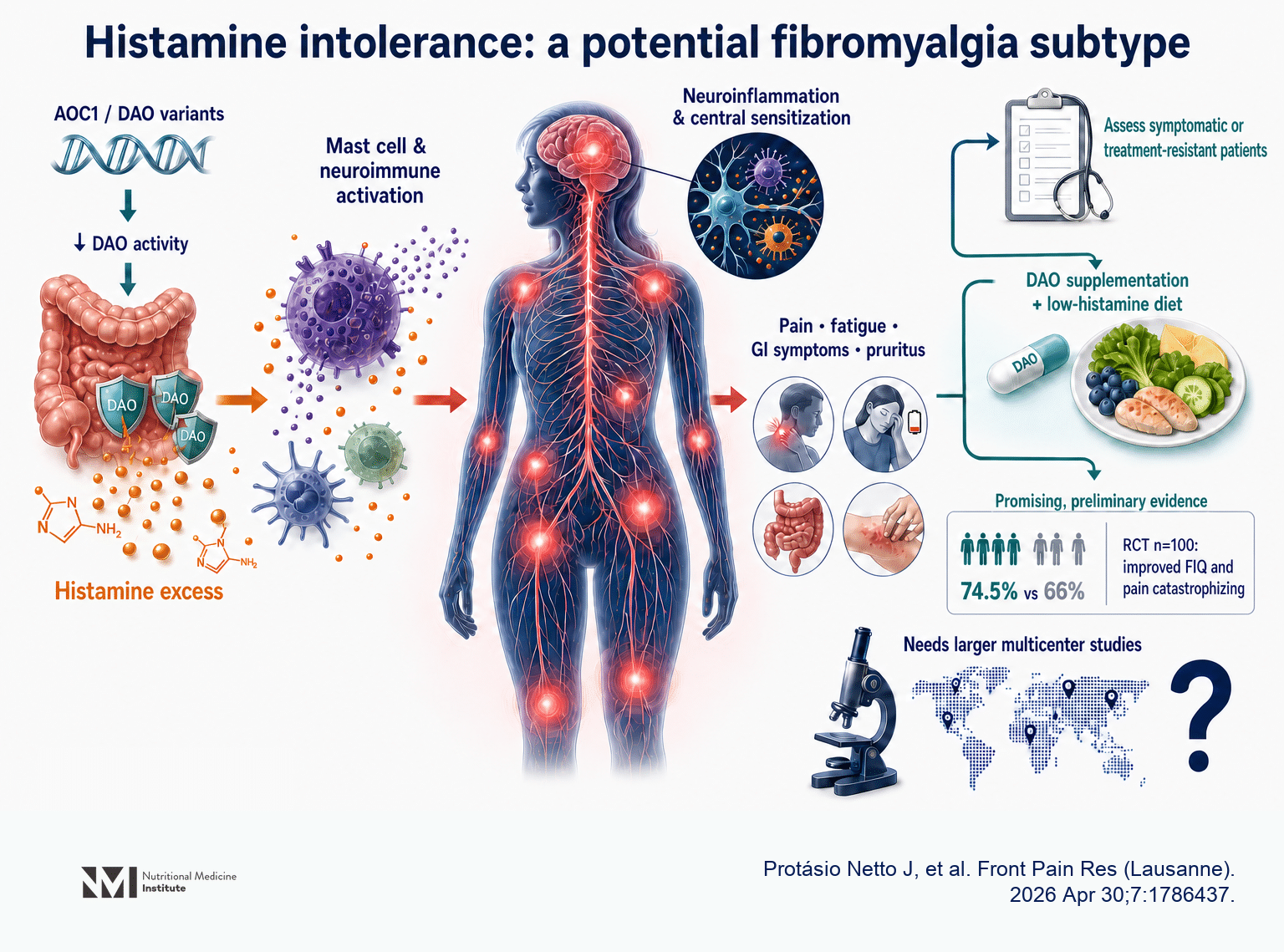
The proposed biology is compelling, if still incomplete. Histamine is released by immune cells called mast cells and acts through several receptors in the gut, skin, immune system and nervous system. The authors describe a possible feedback loop: histamine activates pain pathways and inflammatory cells; these cells then release more signals that heighten sensitivity. In the brain and spinal cord, microglia—the nervous system’s resident immune cells—may help sustain this state of “central sensitisation,” in which ordinary sensory input is experienced as disproportionately painful. Stress could add fuel, since it can activate mast cells and worsen both gut symptoms and pain.
For clinicians, the article argues for something more measured than declaring a new cause of fibromyalgia. It proposes asking about a particular constellation: prominent digestive symptoms, chronic itching or flushing, multiple allergic complaints, food-linked symptom flares, and poor response to usual treatment. In such patients, a carefully supervised low-histamine elimination-and-reintroduction trial, consideration of DAO activity or genetic testing where available, and a review of medications and gut health may be reasonable. DAO supplements, dietary adjustments, antihistamines or mast-cell-directed approaches could then be considered as adjuncts to established fibromyalgia care.
“Histamine intolerance” remains difficult to define and diagnose consistently. DAO tests are not standardised; normal blood levels may not reflect what is happening in the gut; histamine itself is rapidly metabolised; and symptoms such as bloating, headache, fatigue and itch have many possible causes. Diets that cut fermented, aged and preserved foods can also become unnecessarily restrictive if pursued without nutritional therapy or dietetic support.
Although a promising hypothesis, the evidence base is small, centred largely on European—especially Spanish—populations, and heavily weighted toward women. The pivotal treatment study needs independent replication, longer follow-up and comparison with other approaches. Fibromyalgia itself is heterogeneous: histamine dysregulation may be relevant for some people, but it is unlikely to explain every case.
The most useful takeaway is therefore not “fibromyalgia is histamine intolerance.” It is that fibromyalgia may contain biologically distinct subtypes, and one of them could be more histamine-sensitive than we have recognised. For people whose pain comes with gut symptoms, itch, allergies or clear food-related flares, that possibility deserves rigorous study—and perhaps a cautious, individualised clinical trial.