Aug 13, 2026
Benjamin Brown
Saffron is already one of the world’s most coveted spices: delicate red threads with a price to match, prized in cooking for colour, aroma and a slightly honeyed bitterness. It has also, increasingly, become a serious subject for mental-health researchers. A new clinical trial led by Dr Adrian Lopresti asks whether a standardised saffron extract might help a particularly overlooked group: women aged 50 to 70 experiencing both low mood and poor sleep.
The findings are encouraging.
In the 12-week study, 86 women were randomly assigned to take either 28 mg daily of the branded saffron extract Affron® or an identical placebo.1 Neither participants nor researchers knew who received what until the data were collected. All participants had mild to moderately severe depressive symptoms and sleep difficulties at the outset – a combination that becomes especially common around and after the menopausal transition.
Study highlights:
- Clinically meaningful improvement in depressive symptoms: Women taking 28 mg/day of a standardized saffron extract for 12 weeks were almost twice as likely to achieve a clinically meaningful improvement in depressive symptoms compared with placebo (48.8% vs 25.6%).
- Benefit observed despite a strong placebo response: Although both groups improved over the course of the trial, the saffron group demonstrated significantly greater reductions in depression scores, supporting a treatment effect beyond placebo.
- Improved daytime functioning rather than sleep quality: Saffron did not significantly improve self-reported sleep disturbance, but it did improve sleep-related impairment, including daytime tiredness, alertness, concentration, and irritability.
- Well tolerated: The extract was associated with no serious adverse events and high tolerability, supporting its potential role as an adjunctive option for women with mild depressive symptoms.
By the end of the trial, both groups had improved, which is common in studies of mood and sleep. But the saffron group improved more on the study’s main measure of depressive symptoms. Their average depression score fell by 6.4 points, versus 4.0 points in the placebo group. More strikingly, 48.8% of women taking saffron achieved what the researchers had defined in advance as a clinically meaningful improvement, compared with 25.6% taking placebo. In practical terms, the study suggests that treating roughly four or five women with the extract might produce one additional meaningful response beyond what would occur with placebo. That is a respectable signal for a small nutritional trial, particularly since depression studies are notoriously susceptible to placebo effects.
Saffron did not significantly improve the participants’ reported sleep disturbance – the measure closest to asking whether they slept better. It did, however, improve “sleep-related impairment”: daytime tiredness, alertness, concentration and irritability. Those outcomes may be valuable, but they overlap substantially with the symptoms of low mood. It is therefore difficult to say whether saffron improved sleep itself, improved mood and thereby made days feel more manageable, or did some combination of both.
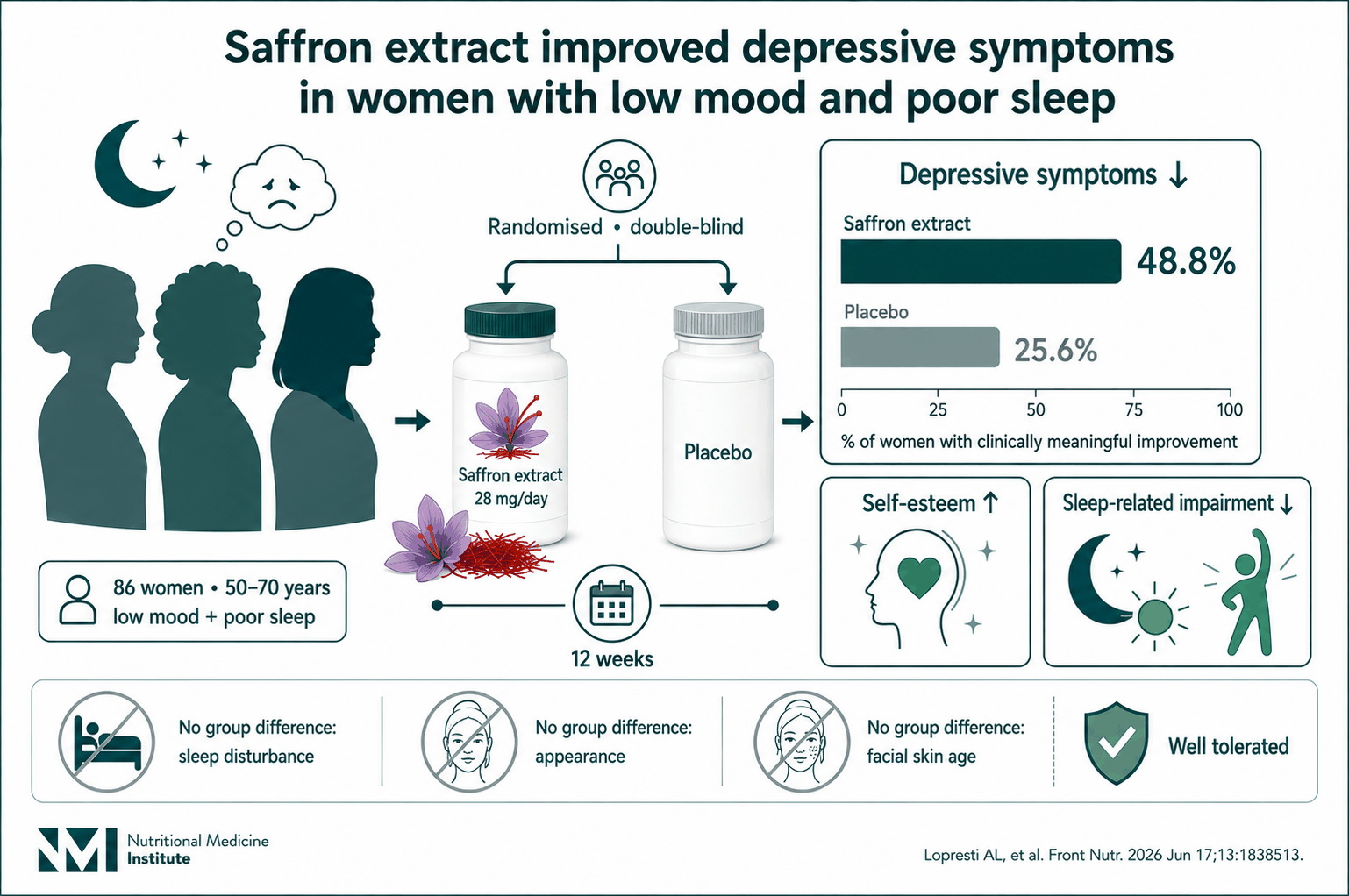
There was another intriguing result. Women taking saffron showed a modestly greater improvement in self-esteem than those taking placebo. The effect was small, and self-esteem was not the study’s main target, so it is best treated as a lead for future research. The same applies to the trial’s more eye-catching cosmetic angle. Researchers used questionnaires and an AI-based facial-age app to assess appearance and skin ageing. Saffron made no difference to either. In other words: there is no evidence here that saffron turns back the clock in the mirror.
The trial does, however, sit within a larger body of evidence that makes it more than a curiosity. A 2026 systematic review and meta-analysis pooled 34 randomised controlled trials involving 1,769 adults.2 It found that saffron supplementation reduced scores on two common self-report measures of depression and anxiety. The review rated the overall certainty of this evidence as moderate. Yet it also found no significant benefit on clinician-rated depression or anxiety scales, and the included studies varied greatly from one another. That distinction is important: the evidence is more persuasive for people reporting fewer symptoms than for a clearly established treatment effect confirmed by clinicians. The meta-analysis therefore frames saffron as a potentially useful complementary intervention, not an alternative standard of care.
That wider picture also helps explain why this new trial matters. Rather than testing saffron in a generic adult population, it looks at a life stage in which sleep disruption, mood changes and concerns about ageing often arrive together. It found a moderate-sized advantage for depressive symptoms, no serious adverse events, and high reported tolerability. These are useful results – especially for people who are curious about non-pharmaceutical options or cannot readily access conventional care.
Still, the sample size was modest, the intervention lasted only three months, and all key mood and sleep outcomes were self-reported. The sleep outcome most directly about sleep quality was negative. The study also tested a particular standardised extract, not saffron in general; one cannot assume that a supermarket spice jar or another supplement will have the same composition or effect.
Saffron is emerging as a plausible adjunct for mild depressive symptoms, with this trial adding a focused, carefully blinded data point for women aged 50 to 70.