
Nov 2, 2026
Benjamin Brown
Structured consumption of fresh apples may offer a surprisingly practical approach to birch pollen food allergy syndrome (PFAS). Mueller and colleagues report that gradually increasing apple exposure produced substantial and sustained tolerance, accompanied by immunological changes consistent with allergen-specific modulation.¹
PFAS affects up to 70% of people with birch pollen allergy and arises largely because IgE directed against the birch allergen Bet v 1 cross-reacts with structurally related proteins in plant foods, including the major apple allergen Mal d 1. Current management lacks a standardised treatment, while conventional birch pollen immunotherapy has produced inconsistent effects on associated food reactions. Mueller et al. therefore investigated whether the allergen itself, delivered as fresh apple, could progressively build tolerance.
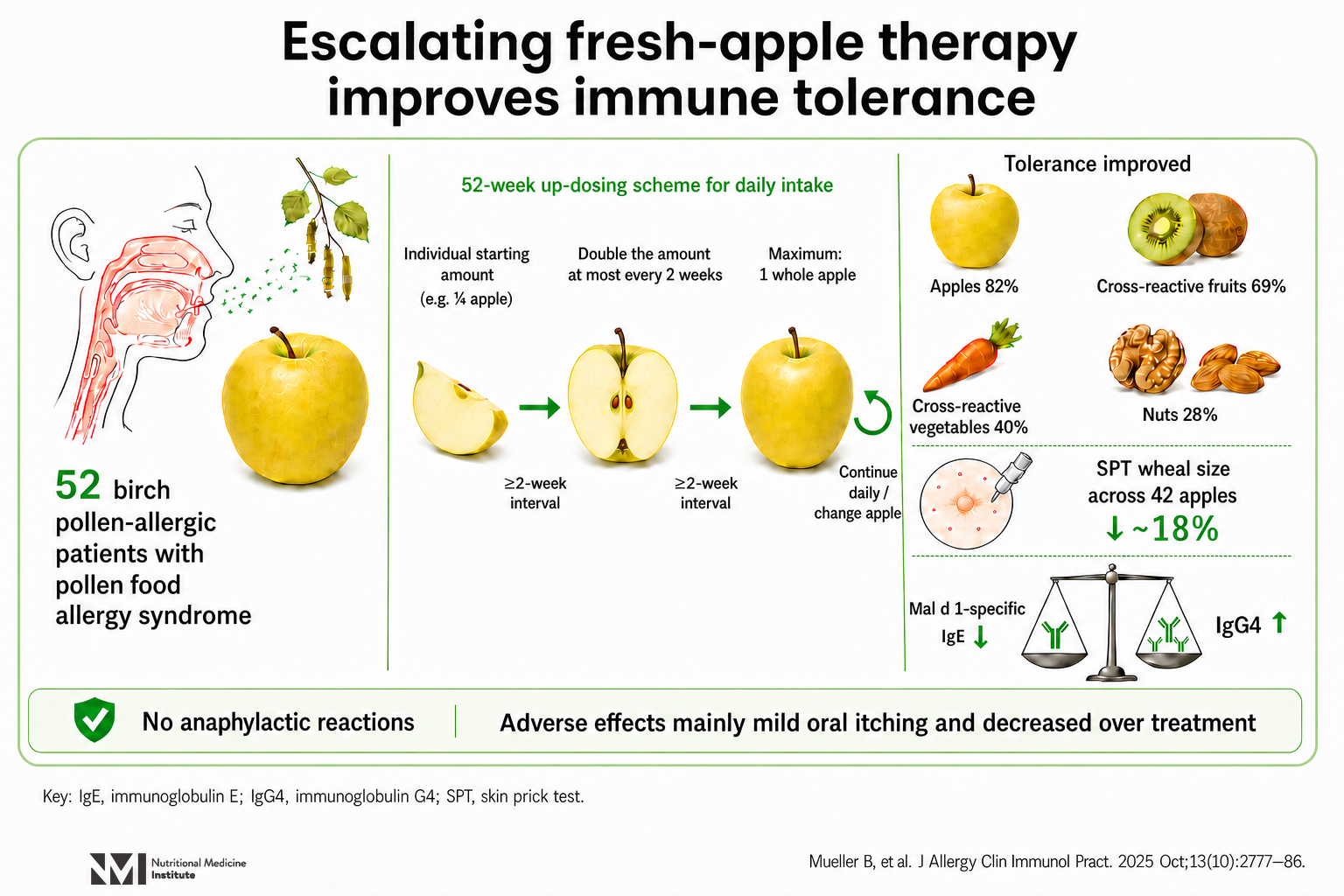
In the uncontrolled phase II/III study, 36 adults underwent 12 months of allergen-specific immunotherapy with apples (AITA), with data subsequently combined with 16 phase II participants. Patients began with individually selected, better-tolerated cultivars and gradually increased the quantity and allergenicity until reaching approximately one apple daily. Importantly for translation into practice, commercially available cultivars were used, with selection informed by skin-prick and oral provocation testing.
The clinical effect was striking. Following treatment, tolerance to the highly allergenic Golden Delicious increased substantially, and 85% of participants were able to consume a whole apple. Tolerance remained elevated following a three-month treatment break, suggesting something beyond temporary desensitisation. Responses to other Bet v 1 cross-reactive foods also improved; reactions to cherry, peach, pear and apricot decreased by 64%. These clinical changes were accompanied by reductions in skin-prick reactivity and Mal d 1-specific IgE, alongside increased Mal d 1-specific IgG4 and IgE-blocking activity.
Study highlights:
- Fresh-apple immunotherapy substantially increased tolerance to a highly allergenic apple cultivar.
- Benefits persisted after treatment withdrawal, suggesting sustained tolerance rather than short-lived desensitisation.
- Tolerance also improved across several cross-reactive fruits, vegetables and nuts.
- Mal d 1-specific IgG4 increased while specific IgE and skin reactivity declined.
- Treatment was generally well tolerated, but allergen exposure was structured and medically supervised.
For clinicians, the accessibility of the intervention is compelling, but the findings should not be interpreted as encouragement for patients with PFAS to begin unsupervised apple challenges. Adverse effects were commonest during initiation, cultivar changes and periods of high pollen exposure; three participants out of 70 (4.3%) discontinued because of adverse events such as abdominal pain and diarrhoea, persistent itching in the mouth and ears, itching and swollen eyes, oral mucositis, and oropharyngeal pain. The most common adverse events in the cohort were itching or scratching of the mouth and throat (up to 85%) followed by oropharyngeal pain (12%), lip swelling (10%), dysphagia (10%), and pharyngeal oedema (8%). Importantly, no anaphylactic reactions were reported.
Commenting on their findings, the authors note that “AITA is an inexpensive, highly effective treatment for PFAS with minimal side effects that can be conveniently used at home, saves time, has shown high patient satisfaction, has good potential for clinical use in practice, and has other health benefits in addition to oral desensitization. For those reasons, we think the time is ready to recommend this treatment under medical supervision to patients with PFAS who suffer a significant reduction in quality of life.”
In summary, Mueller et al. demonstrate that carefully structured, progressive exposure to fresh apples may induce clinically meaningful and potentially durable tolerance in birch pollen-associated PFAS. The accompanying immunological changes strengthen the biological case, while the use of ordinary foods makes the approach unusually practical — but the uncontrolled trial design warrants caution.