
Nov 2, 2026
Benjamin Brown
Iodine deficiency remains a concern during pregnancy, even in countries with established iodised salt programmes. A study in the British Journal of Nutrition suggests that iodine supplementation and dietary intake are important determinants of maternal iodine status, while serum thyroglobulin may offer additional insights into iodine sufficiency and pregnancy outcomes.
Iodine is essential for thyroid hormone synthesis and foetal neurological development, with requirements increasing substantially during pregnancy. However, assessing iodine sufficiency in individual patients remains challenging because urinary iodine concentrations primarily reflect recent intake. In a new study, Censi and colleagues investigated iodine status, dietary determinants and the potential utility of serum thyroglobulin (Tg) as a complementary biomarker in pregnancy.1
Study highlights:
- Only 34.1% of women achieved a sufficient urinary iodine-to-creatinine threshold of ≥150 µg/g.
- Iodine supplementation was associated with nearly threefold higher odds of reaching this threshold.
- Regular cow’s milk consumption independently predicted better iodine status.
- Serum thyroglobulin was inversely associated with iodine status but demonstrated limited diagnostic accuracy.
- Higher thyroglobulin was associated with less favourable birth outcomes, although effect sizes were small.
The cross-sectional study enrolled 528 women in their third trimester in north-eastern Italy. Among 499 women with urinary iodine-to-creatinine (UI/Creat) measurements, the median concentration was 112.8 µg/g, with only 34.1% achieving the desirable range of ≥150 µg/g. Despite widespread use of iodised salt (76.9%) and iodine-containing supplements (74.2%), inadequate iodine status remained common.
Dietary and supplemental iodine emerged as important determinants. Women taking iodine-containing supplements had significantly higher median UI/Creat concentrations than non-users (127.9 versus 77.1 µg/g). Multivariable analysis identified supplementation and regular cow’s milk consumption as independent predictors of achieving ≥150 µg/g. Iodised salt use alone showed no significant association.
These findings reinforce the importance of assessing dietary iodine sources and supplement use during antenatal consultations, particularly among women avoiding dairy products or following restrictive diets.
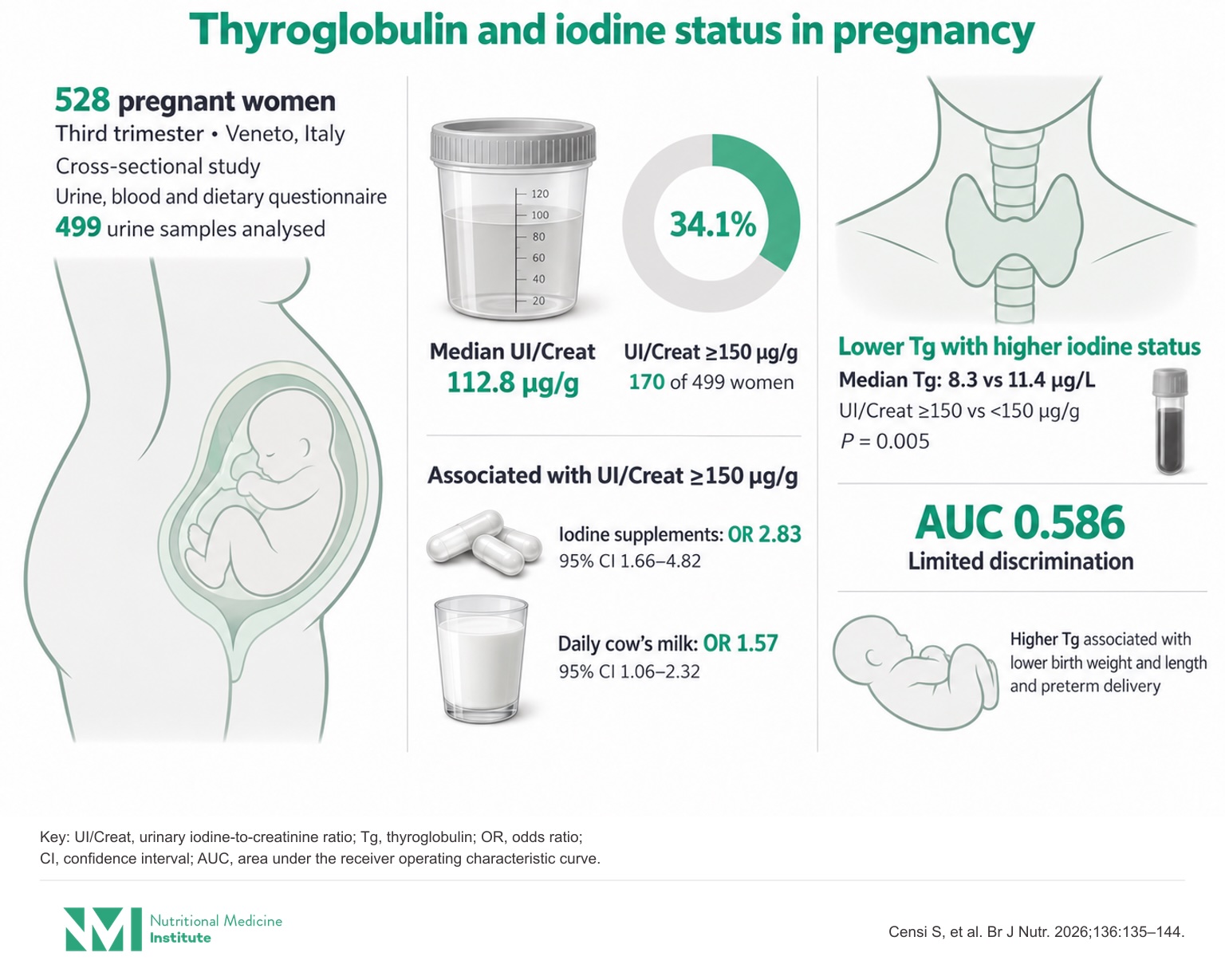
The investigation also explored Tg as an indicator of longer-term iodine status. Women meeting the urinary iodine threshold had significantly lower median Tg concentrations than those below it (8.3 versus 11.4 µg/L). A proposed Tg threshold of ≤10.61 µg/L for iodine insufficiency demonstrated limited discriminatory performance, restricting its immediate clinical applicability.
Higher maternal Tg was also associated with lower neonatal birth weight and length and increased odds of preterm delivery. However, these associations were relatively weak, and conventional thyroid function markers showed little relationship with urinary iodine status. Furthermore, Tg measurements may be influenced by thyroid pathology and thyroglobulin antibodies. Nonetheless, this is the first published evidence to suggest Tg can predict neonatal parameters and pregnancy outcomes.
Overall, the findings highlight persistent iodine inadequacy during pregnancy despite established public health measures. For clinicians, dietary assessment and appropriate iodine supplementation remain central considerations while Tg may provide complementary information about longer-term iodine status.
“Tg may be a possible proxy of iodine adequacy in the third trimester of pregnancy, a reliable marker of thyroid function and a factor associated with maternal and neonatal outcomes during pregnancy,” concluded the study authors.