

Nov 2, 2026
Benjamin Brown
A trial published in Nutritional Psychiatry put urinary kryptopyrrole testing under controlled clinical scrutiny, examining whether this proposed biomarker meaningfully tracks symptoms of generalised anxiety.1 Their findings challenge its clinical validity: associations with anxiety were inconsistent, diagnostic performance was poor, and changes in symptoms were not reliably reflected by urinary kryptopyrrole concentrations.
Kryptopyrrole testing has a long and controversial history. The concept of pyrroluria—historically associated with the “mauve factor”—proposes that elevated urinary pyrroles are associated with depletion of zinc and vitamin B6 and, in turn, psychiatric symptoms including anxiety, depression and schizophrenia. In 2021, Warren and colleagues systematically examined this evidence in Pyroluria: Fact or Fiction?2 Of 73 articles identified, only three reported significantly higher hydroxyhemepyryrrolin (HPL) levels in psychiatric populations, while 13 other clinical studies either found no association or provided insufficient evidence of group differences. Crucially, the review found no clear evidence that elevated urinary HPL was robustly associated with mental health symptoms, caused increased loss of zinc or B6, or identified patients who would benefit from high-dose supplementation. The authors concluded that HPL testing could not be recommended as a screening or treatment tool.
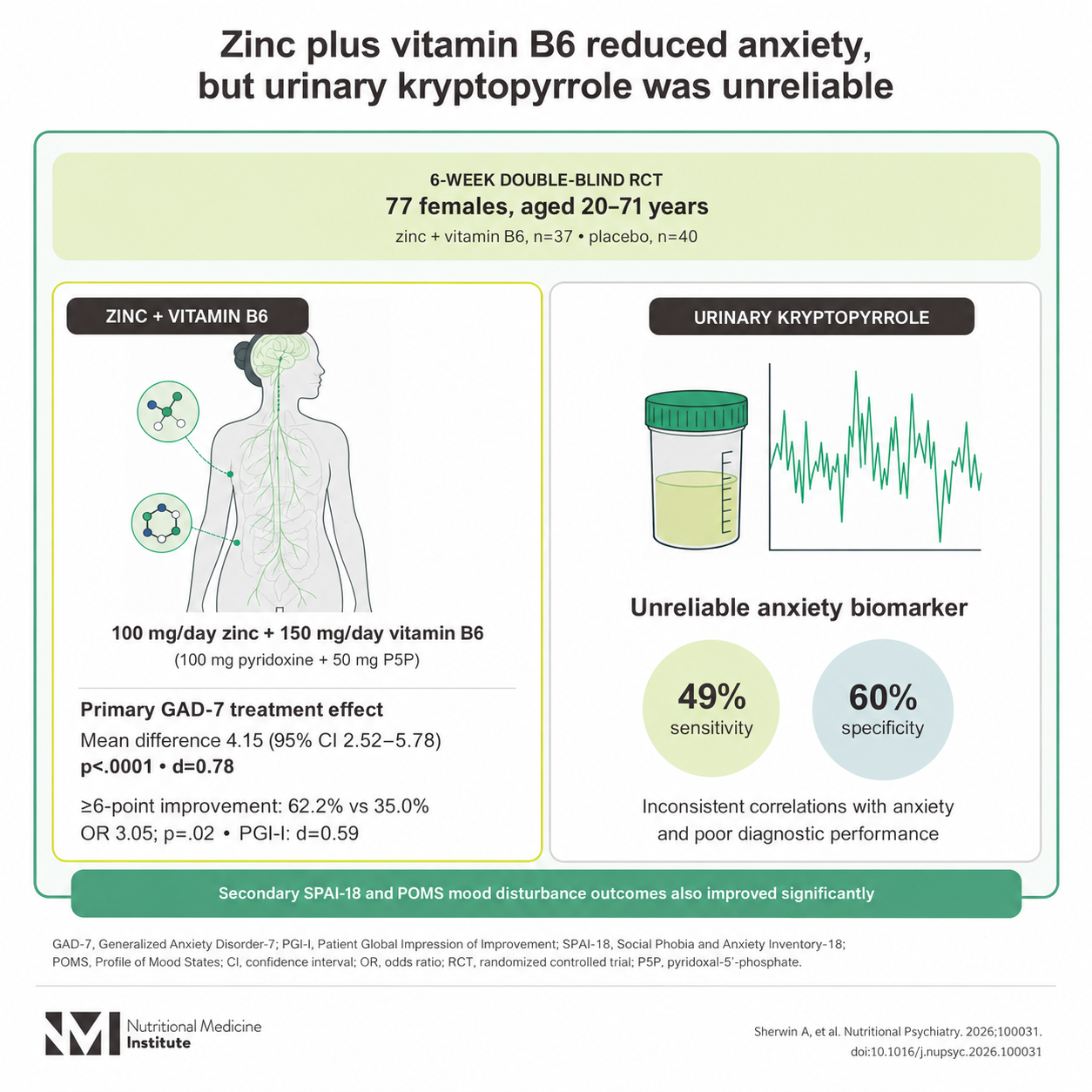
The new study by Sherwin et al. provides an important experimental extension of those concerns. Seventy-seven participants assigned female at birth with moderate-to-severe self-reported anxiety entered a six-week double-blind randomised placebo-controlled trial. Urinary kryptopyrrole concentrations were measured alongside the Generalized Anxiety Disorder D7questionaire (GAD-7) while participants received either placebo or high-dose zinc and vitamin B6 (100 mg as zinc picolinate and 150 mg as pyridoxine and pyridoxal-5-phosphate daily). The study therefore allowed investigators to ask not only whether the nutrients affected anxiety, but whether kryptopyrrole behaved as a meaningful biological marker of symptoms or treatment response.
At baseline, moderate positive correlations between kryptopyrrole concentrations and GAD-7 scores were observed in both groups. However, these associations disappeared by the end of the trial, and removal of individual outliers further weakened some findings. Overall, the biomarker demonstrated a sensitivity of only 49% and specificity of 60%. This inconsistency matters clinically: a useful biomarker should reliably distinguish relevant clinical states and, where proposed for treatment monitoring, demonstrate a meaningful relationship with symptom change. Kryptopyrrole did neither convincingly.
Study highlights:
- Urinary kryptopyrrole demonstrated poor sensitivity (49%) and specificity (60%) for anxiety symptoms.
- Initial correlations between kryptopyrrole and GAD-7 scores disappeared during the trial.
- Anxiety improved significantly with zinc/B6 despite no consistent relationship between improvement and urinary kryptopyrrole.
- Current evidence does not support kryptopyrrole testing for identifying or monitoring patients with anxiety.
An important distinction emerges from the nutrient results. Zinc/B6 supplementation produced a significantly greater reduction in GAD-7 scores than placebo, with 62.2% of treated participants achieving a clinically significant ≥6-point improvement compared with 35.0% receiving placebo. Yet kryptopyrrole concentrations did not reliably track these improvements. This helps separate two hypotheses that have frequently been intertwined: zinc and B6 may have effects relevant to anxiety, but those effects do not establish pyrroluria as the underlying mechanism or validate urinary kryptopyrrole testing.
The analytical uncertainty surrounding the test adds another layer of concern. Kryptopyrrole measurements may be influenced by analyte instability, sample handling, exposure to air or light and differences in analytical methodology, potentially generating false-positive or false-negative findings.
In summary, despite promising effects of zinc/B6 on anxiety symptoms, kryptopyrrole itself performed poorly as a biomarker. For clinicians, this distinction is important: nutritional interventions deserve consideration, but the available evidence does not support urinary kryptopyrrole testing as a reliable clinical tool for anxiety.