

Aug 13, 2026
Benjamin Brown
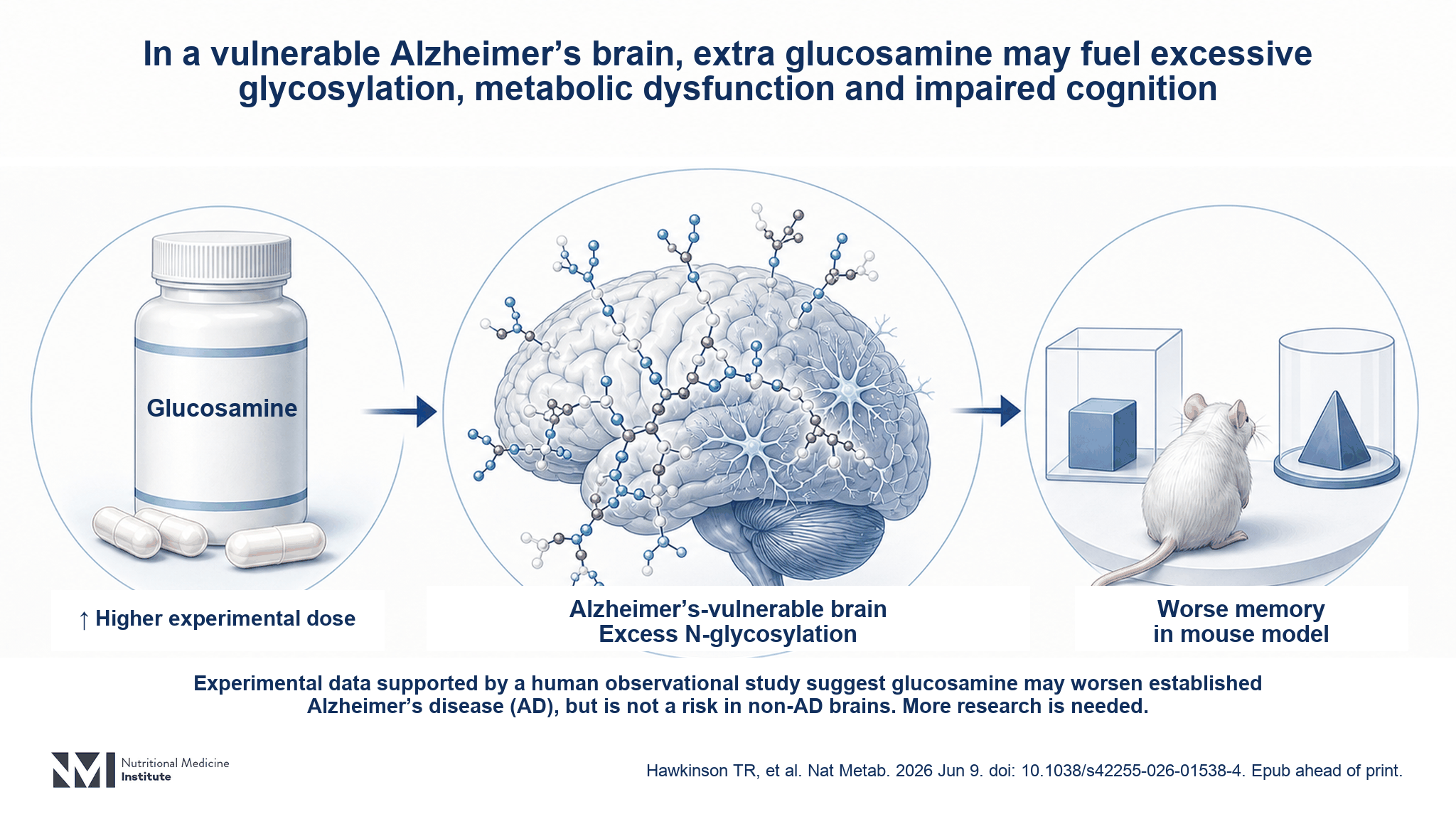
Glucosamine, the familiar joint-health supplement, has become an unexpected focus of Alzheimer’s research. A new Nature Metabolism paper suggests that in brains already affected by Alzheimer’s-like disease, glucosamine may feed an abnormal metabolic process and worsen memory problems.
That is an important finding. It is not, however, a reason to conclude that glucosamine causes Alzheimer’s disease or that everyone with cognitive impairment should stop taking it. The evidence is new, biologically plausible and worth taking seriously – but it remains incomplete and, in humans, conflicting.
Study highlights:
- Glucosamine worsened cognition in an Alzheimer’s mouse model: Oral glucosamine supplementation increased brain N-glycan levels and impaired social-recognition memory in mice with Alzheimer’s-like disease, whereas reducing glycan production improved memory performance.
- Potential effect appears disease-specific: Glucosamine supplementation did not impair cognition or increase N-glycan levels in healthy mice, suggesting that any adverse effects may be limited to brains already affected by Alzheimer’s pathology rather than representing a universal risk.
- Human observational findings are hypothesis-generating, not definitive: Retrospective analyses suggested associations between glucosamine use and higher mortality in established dementia, and faster progression from mild cognitive impairment to dementia. However, these data cannot establish causality because of important limitations, including potential confounding, uncertain supplement exposure, and reverse causation.
- Clinical implications remain uncertain: The findings support further investigation of glycan metabolism as a therapeutic target but do not demonstrate that standard-dose glucosamine supplements accelerate Alzheimer’s disease in humans. Prospective clinical studies are needed before changes to clinical practice can be recommended.
Glucosamine is usually taken for osteoarthritis and joint symptoms. Biologically, it is more than a joint supplement: once absorbed, it can enter the body’s hexosamine pathway, which helps cells make the sugar-based chains called glycans. Glycans are attached to proteins through a process called glycosylation. This is an essential part of normal cell biology, helping proteins fold, move and signal correctly. In the brain, glycosylation supports synapses, immune communication and the blood-brain barrier.
Hawkinson and colleagues1 found that brains affected by Alzheimer’s showed unusually high levels of a particular class of protein-associated glycans, known as N-glycans, a feature known as hyperglycosylation. The increase was seen in post-mortem human brain tissue, rose with the severity of Alzheimer’s pathology, and appeared in mouse models of both amyloid- and tau-related disease.
The investigators then used isotope tracing to identify the likely cause. The Alzheimer’s-model brains were not simply failing to clear old glycans; they were making new ones faster. That led to a simple but provocative question: if glycan production is already overactive, what happens when more glucosamine becomes available?
In one Alzheimer’s mouse model, 5xFAD, the researchers gave glucosamine by mouth for two weeks. The treatment increased N-glycan abundance across the brain and worsened performance in a social-recognition memory test. The reverse experiments reinforced the idea. When the team reduced glycan production genetically or used a compound that inhibits N-glycan attachment to proteins, N-glycan levels fell and memory performance improved.
Together, these experiments support a mechanistic hypothesis: in a vulnerable Alzheimer’s brain, extra glucosamine may act as fuel for excessive glycosylation, adding to metabolic dysfunction and impairing cognition. It is also notable that the interventions changed behaviour without changing amyloid plaque burden or tau pathology over the short study period. That suggests glycan metabolism could affect brain function independently of the field’s most familiar disease hallmarks.
The dose deserves attention. The mice received 457 mg/kg/day, administered by oral gavage. The paper translates this using standard animal-to-human scaling to about 36 mg/kg/day in humans – approximately 2.9 g daily for an 80 kg adult. Many glucosamine food supplements provide 1.5 g daily or less. The experimental equivalent was therefore close to twice a typical supplement dose.
This does not make the mouse result irrelevant. High-dose experiments can reveal important biological mechanisms. But it limits how directly the result can be applied to everyday supplement use. Animal-to-human conversions are approximations, and receiving a controlled dose by gavage is not the same as a person taking a standard supplement tablet or powder.
There is another important qualification: glucosamine did not produce the same effect in healthy wild-type mice. In those animals, two weeks of supplementation did not significantly raise N-glycans or impair social memory. The potentially adverse effect appeared in mice with established Alzheimer’s-like disease, suggesting a disease-specific vulnerability rather than a universal detrimental effect.
The authors also reviewed health records from more than 50,000 people with Alzheimer’s disease-related dementias. Among people with established dementia, documented glucosamine use was associated with a 25% higher mortality risk. Among people with mild cognitive impairment, use was associated with a higher rate of later progression to dementia.
These are signals that justify further investigation. But they cannot establish that glucosamine caused the outcomes. The data came from retrospective medical records rather than a randomised clinical trial. An important limitation was that glucosamine use was defined as the presence of the word ‘glucosamine’ in medical records so dose, duration or indeed use cannot be confirmed. People who take glucosamine may differ systematically from those who do not: in arthritis severity, chronic inflammation, pain, mobility, other illnesses, medicines, diet or healthcare use. Although the authors adjusted for some characteristics, no record-based analysis can completely rule out these influences.
Reverse causation is possible. Glucosamine is often taken for osteoarthritis, and osteoarthritis-related inflammation, reduced physical activity and other associated health factors could themselves affect dementia risk or survival.6
Earlier large-scale observational studies have reported either protective or no relationship. Glucosamine use has been associated with improved cognitive function.5 One UK Biobank study of 494,814 participants associated regular glucosamine use with lower risk of all-cause dementia, Alzheimer’s disease and vascular dementia.7 Another found a lower risk of vascular dementia, but no significant association with Alzheimer’s disease or frontotemporal dementia.8 A further large prospective study found no association with incident dementia or Parkinson’s disease.9
These studies cannot prove glucosamine is protective; they are observational and subject to many of the same limitations. But they do show that the new study does not settle the clinical question. These observations don’t necessarily contradict the findings of Hawkinson and colleagues, it may be that glucosamine is safe and potentially protective in people who do not have established Alzheimer’s disease, but not in those that do.
Animal evidence is mixed as well with experimental evidence reporting neuroprotective effects of glucosamine,2-4 though these studies used different models and cannot be directly compared with the new Alzheimer’s experiment.
The new research makes hyperglycosylation a compelling target for Alzheimer’s research and raises a legitimate question about glucosamine in people with established neurodegenerative disease. It does not show that standard-dose glucosamine supplements accelerate Alzheimer’s in humans.
What is needed now is a well-designed clinical study that measures dose, duration, formulation, cognitive status, co-existing osteoarthritis and other health factors, and follows participants prospectively. Until then, glucosamine should be regarded as an unresolved question in Alzheimer’s care – neither a proven danger nor a proven neuroprotective supplement.
Anyone considering starting or stopping glucosamine, particularly if they have cognitive impairment or dementia, should discuss it with their health professional.