
Aug 13, 2026
Benjamin Brown
What if food science has been asking too small a question? For more than a century, nutrition has largely treated food as a ledger of calories, proteins, fats, vitamins and minerals. That approach has saved lives and remains indispensable. But a provocative new review, “Quantum food and nutrition,” argues that it misses a wider story: humans are not nourished by food alone, but by a constant exchange of energy, light, rhythms and signals with the living planet around us.
The authors, including lead author Professor Mark Wahlqvist, call this proposed field “quantum nutrition.” It is not a diet plan, nor an argument that ordinary nutrition should be discarded. Rather, it is an invitation to examine how the strange but real rules of quantum physics – the behaviour of particles and energy at very small scales – may help explain some of biology’s remarkable efficiencies.
Study highlights:
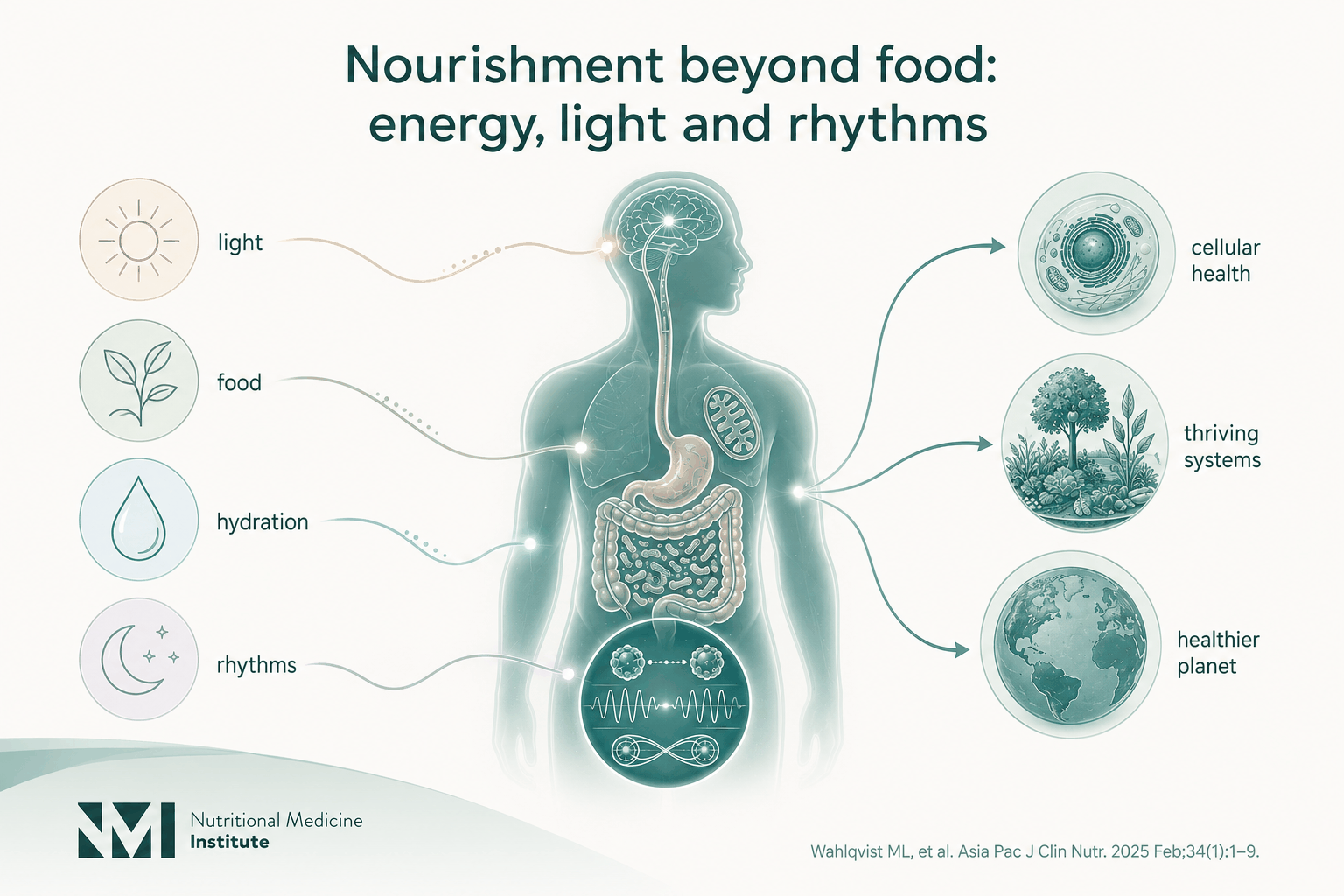
- Introduces the concept of “quantum nutrition”: The review proposes that nutrition should extend beyond nutrients and calories to consider how energy, light, biological rhythms and environmental interactions may influence human health.
- Emphasises the importance of food structure and biological context: The authors argue that the health effects of food depend not only on its nutrient content but also on the food matrix, gut microbiome interactions, meal timing and environmental context.
- Links circadian biology with nutrition: Sunlight and daily biological rhythms are highlighted as key regulators of metabolism and health, reinforcing the importance of aligning eating and lifestyle behaviours with natural circadian cycles.
- Potential future clinical applications: The review discusses emerging research into quantum-sensitive biological processes, including possible roles for electromagnetic fields, quantum sensing and nanotechnology in diagnosis and therapy.
At its most convincing, the argument begins with familiar ground. Photosynthesis, for example, captures sunlight with extraordinary efficiency; biological processes also depend on electrons moving through molecules, sometimes via quantum tunnelling. In our own cells, mitochondria convert food-derived fuel into usable energy. The review suggests that a fuller understanding of these microscopic processes could eventually sharpen how we think about metabolism, disease and ageing.
That is a substantial shift in perspective. A calorie is not simply a calorie in the body: food arrives as a physical structure, with texture, aroma, colour, timing and a relationship to the gut microbiome. The authors argue that nutrition needs to pay more attention to the food matrix – the complex architecture of a meal – as well as the contexts in which it is grown, prepared and eaten.
Light is central to their story. Sunlight helps regulate our internal clocks, sleep and wakefulness, vitamin D production, and potentially aspects of gut biology. This is mainstream territory in chronobiology. The paper uses it to make a broader point: our bodies are rhythmic systems, continually synchronising with day and night, season, place and social routine. In that sense, breakfast at a bright window, a walk outdoors and a regular bedtime may matter not only because they feel healthy, but because they keep biological timing systems aligned.
From there, the review travels into more ambitious territory. It suggests that weak electromagnetic fields, ultra-low-level light emission from living tissues, and quantum-sensitive molecules might someday offer new ways to diagnose or treat illness. Possible applications include using electromagnetic fields to support wound healing, quantum dots as tools for imaging or drug delivery, and quantum sensing to monitor soils, crops and ecosystems more precisely.
These ideas should be read with care. Some are active areas of scientific research; others are hypotheses or long-range possibilities, not proven medical interventions. The paper’s language occasionally reaches far beyond the evidence currently available – especially when linking quantum effects to consciousness, inherited health effects or broad “cosmic” influences on nourishment. Readers should not infer that special quantum foods, consumer devices or electromagnetic therapies are established cures. They are not.
Overall, some of the themes are active areas of scientific research; others are hypotheses or long-range possibilities. Still, the broader challenge is worth taking seriously. Modern food problems do not begin and end on the dinner plate. Climate change, degraded soils, biodiversity loss, food-system inequality and disrupted daily routines all shape health. The review’s most salient message may be nutrition is ecological: people thrive through relationships among bodies, communities, food systems and environments.
Its practical dietary message will be familiar ground. The authors favour diverse, minimally stored foods, cooking and fermentation where appropriate, proximity to food sources, and dietary biodiversity. Those recommendations sit comfortably alongside conventional nutritional advice. What quantum biology adds, in their view, is a new scientific lens for understanding why biological systems are so interconnected – and perhaps for designing smarter tools to protect them.
“Quantum nutrition” may prove to be a useful discipline and is an exciting area for future investigation. The paper is a reminder that eating is not merely refuelling. It is participation in an elaborate exchange of chemistry, energy, time, culture and ecology – one that begins in the smallest particles and reaches all the way to the health of the planet.