

Aug 10, 2026
Benjamin Brown
Modern breast cancer medicine has become remarkably good at confronting the tumour itself. Diagnosis is sharper, surgery more precise, drugs more targeted and survival rates higher. Yet for many women, the treatment journey still leaves a conspicuous gap: who is looking after the sleep deprivation, the fear, the menopausal symptoms, the loss of confidence in one’s body, the exhaustion, the questions about food, movement and sex?
A new UK study from Synthesis Clinic argues that these concerns should not be treated as peripheral extras. They are part of cancer care—and a coordinated, medically supervised form of integrative oncology may offer one practical way to address them.
Study highlights:
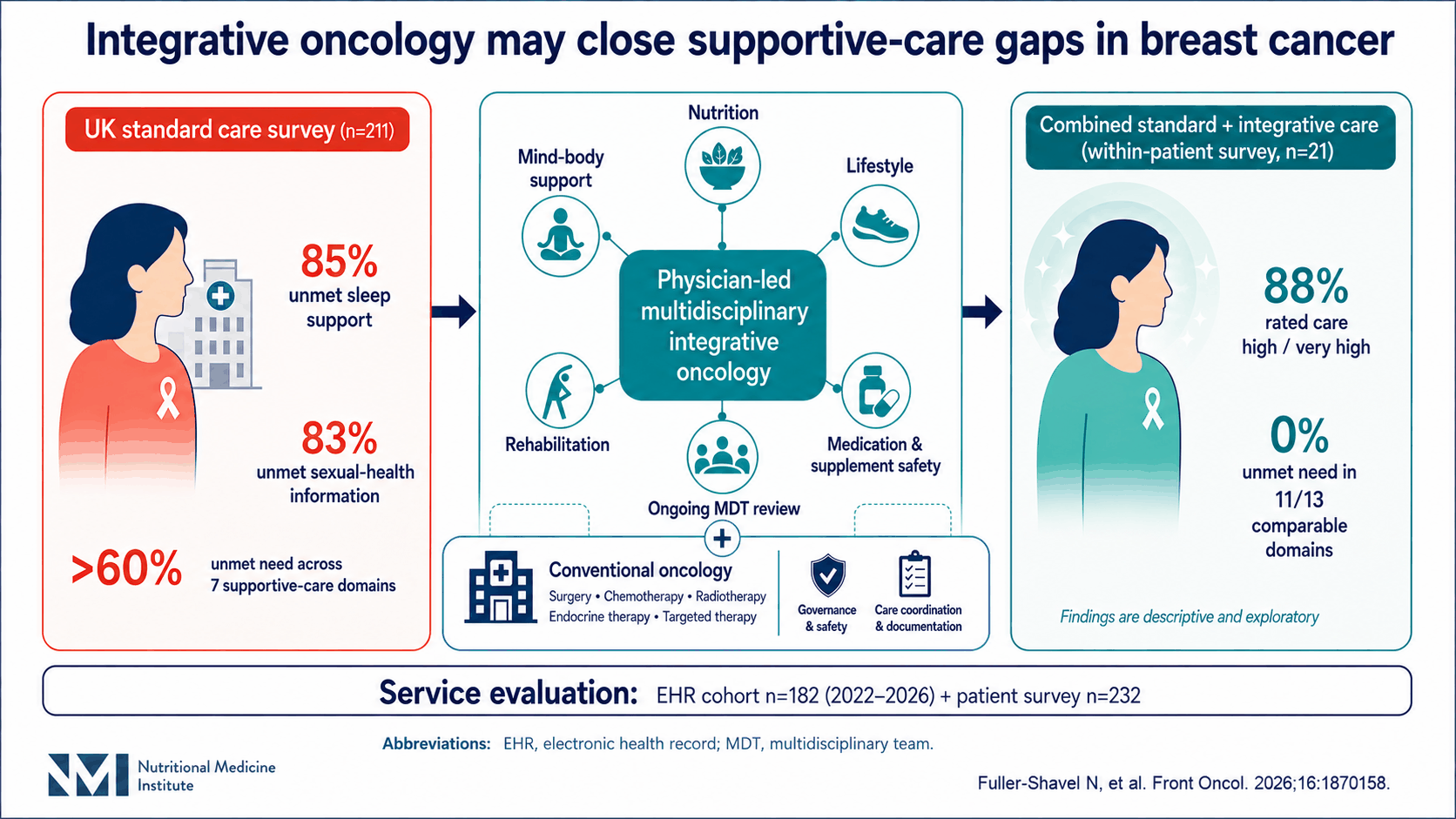
- Substantial supportive care gaps: Among 211 UK women with current or previous breast cancer, 85% reported unmet needs for sleep support and 83% for sexual health information and support, with additional gaps in nutrition, exercise and wellbeing services.
- Integrative oncology complemented standard treatment: The clinic’s multidisciplinary model combined physician oversight with nutrition, rehabilitation, psychological support and selected complementary therapies alongside conventional cancer care, with safety screening for supplements and herbs.
- Patients reported markedly improved supportive care: In a subgroup of women who had experienced both conventional and integrative care, unmet supportive care needs fell to zero in 11 of 13 comparable domains, with particularly strong improvements in sleep, nutrition, exercise and person-centered care.
- Policy implications: The authors propose specialist, community-based integrative oncology hubs working alongside NHS cancer services to deliver coordinated supportive care, personalised care planning and routine safety monitoring.
The paper, by Nina Fuller-Shavel, Lauren Watts and Nazanin Derakshan, describes a systems-biology based approach to breast cancer support. Its central idea is straightforward: cancer may be treated in the breast, lymph nodes or bloodstream, but it is lived in a whole person. Good care therefore needs to consider not only disease and treatment, but also nutrition, activity, sleep, emotional wellbeing, social connection, rehabilitation, symptom control and the safety of any supplements or complementary therapies a patient may be using.
That may sound self-evident. The study’s most striking finding is how often it is not happening.
In a survey of 211 UK women with current or previous breast cancer who reported on standard oncology care, the conventional clinical essentials were generally handled well: 89% felt that tests and results had been adequately explained. But supportive care was a much weaker proposition. Eighty-five per cent reported unmet need around sleep support, and 83% around sexual-health information and support. Nutrition, exercise and wellbeing programmes also fared poorly, while many women did not feel empowered in decisions about their own treatment.
This is not an indictment of individual oncologists. It is better understood as a finding about a system under pressure. Cancer services are built to make technically demanding, time-critical treatment decisions. The result, the authors suggest, is that the matters patients often live with every day—fatigue, distress, intimacy, movement, food and recovery—can fall between the cracks of hospital appointments, primary care and charity support.
The paper then turns to the clinic’s own model, which is explicitly not presented as an alternative to conventional cancer treatment. It is designed to run alongside it. The clinic combines physician oversight with nutritional therapy and dietetics, lifestyle support, rehabilitation, psychological and emotional support, and selected complementary therapies such as acupuncture, yoga therapy, herbal medicine or mistletoe where clinically appropriate. Supplement and herb use is screened for interactions, and complex cases are discussed in multidisciplinary meetings.
The study reviewed records from 182 women attending the clinic between 2022 and early 2026. This was not a low-risk, wellness-focused population: nearly 46% had ever had metastatic disease, and one in five had triple-negative breast cancer. Nutrition was the most common part of care, used by 95% of patients, while physician consultations, intravenous nutrient therapy, mistletoe treatment, emotional wellbeing support and rehabilitation were used by smaller, tailored groups.
A smaller survey group—21 clinic patients who had experienced both conventional and integrative care—reported a dramatically more positive experience of supportive care. In within-person comparisons, unmet need fell to zero in 11 of 13 comparable areas. Sleep, nutrition, exercise and feeling treated as a person rather than merely as a cancer diagnosis showed particularly large differences. Patients described the service as a “lifeline” and a source of control at a time that otherwise felt uncontrollable.
Those figures deserve attention, but also restraint. This is not a trial showing that integrative oncology improves survival, prevents recurrence or causes better outcomes. The authors are appropriately clear about that. The integrative-care group was very small, self-selected and drawn from one private specialist clinic; the survey was cross-sectional, meaning it captures experience at a point in time rather than proving cause and effect. Participants were also disproportionately white, well-educated and comparatively affluent—precisely the access problem the paper says must be solved.
That limitation is not a footnote; it is one of the study’s most important messages. A private, specialist service may demonstrate what is possible, but it cannot be the endpoint. If integrated supportive care becomes another benefit reserved for patients with money, confidence, time and geographical proximity, it risks widening the inequities already embedded in cancer care.
The authors therefore make a bigger policy argument. Rather than attempting to bolt a little extra support onto every GP surgery or hospital department, they propose specialist, community-based integrative oncology hubs that work in shared care with NHS cancer teams and primary care. The transferable parts of the model are not necessarily its more specialised treatments. They include the structured assessment of needs, personalised care planning, routine patient-reported outcomes, multidisciplinary working and robust safety checks around supplements and herbs.
This is where the paper is most persuasive. The real innovation is not any single therapy; it is the premise that supportive care should be organised with the same seriousness as anti-cancer treatment. A woman should not have to become her own care coordinator, searching online for advice on insomnia or wondering whether a supplement is safe alongside chemotherapy. Nor should sexual health, psychological distress and physical recovery be left to chance.
The study does not settle the question of how integrative oncology should be funded or which components deliver the greatest value. It does, however, make a compelling case that breast cancer care needs to become more complete. Survival is no longer the only measure of success. Living well through treatment—and beyond it—should be built into the service, not treated as an optional add-on.