What is Nutritional Medicine?
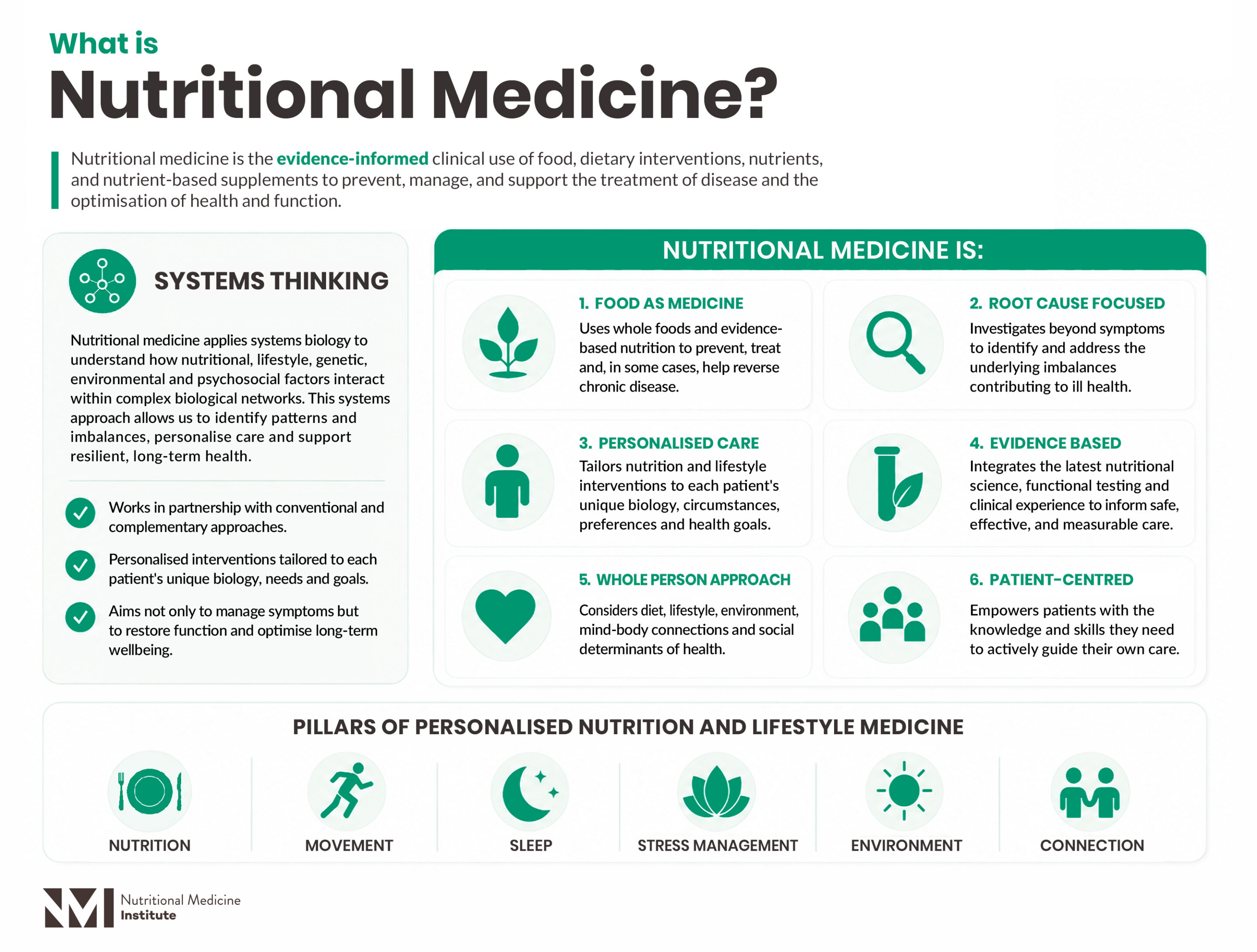
Nutrition medicine is the evidence-informed clinical use of food, dietary interventions, nutrients, and nutrient-based supplements to prevent, manage, and support treatment of disease and the optimisation of health and function. It joins nutritional assessment with medical history, examination, laboratory data, medicines review, and a patient’s goals, resources, culture, and preferences.
Systems-biology thinking informs the personalisation of nutritional medicine. Its purpose is not to replace diagnosis, pharmacotherapy, or specialist care, but to make nutrition a deliberate, monitored component of whole-person clinical management.1


Clinical Intervention
Nutritional medicine differs from general healthy-eating advice because it starts with a specific clinical question: what nutrition-related factors may affect this individual’s symptoms, risk, disease trajectory, treatment tolerance, function, or quality of life?
The answer may be as straightforward as correcting inadequate protein intake after illness or as complex as integrating cardiometabolic risk, gastrointestinal symptoms, food access, and drug–nutrient interactions. The clinician then agrees a feasible intervention, defines outcomes, and reviews response. This clinical approach makes nutritional medicine highly personalised and patient centred.


Personalised Nutrition
Personalised nutrition is a central component of nutrition medicine. Personalised nutrition has been defined broadly as an approach that uses individual-specific information to develop targeted nutritional advice, supplements, and behavioural interventions.2
Relevant information can include phenotype, dietary intake, clinical status, biochemical measures, health behaviours, preferences, and social context; genetic or other “omics” data may sometimes contribute but are not prerequisites.
In practice, personalisation should improve the relevance, safety, and feasibility of care, rather than add testing without a clear decision it will change.
Guided by Evidence
Personalisation does not exempt clinicians from usual standards of evidence. A patient’s individual response matters and is interpreted alongside established dietary evidence, clinical guidelines, disease severity, contraindications, and the expected risks and benefits of an intervention.
Ordovás and colleagues describe personalised nutrition as a developing field that seeks to account for heterogeneity in dietary responses, while recognising that many proposed tools require further validation and demonstration of clinical utility.3
The appropriate level of personalisation is therefore the least complex approach likely to improve a meaningful outcome.

Shared Decisions
A one-to-one nutritional medicine consultation establishes the patient’s priorities and builds a structured baseline. This includes diagnosis and comorbidities; medications and supplements; symptom pattern; anthropometry when relevant; dietary intake and timing; appetite; activity, sleep, stress, alcohol and tobacco; food skills, finances, and culture; and pertinent laboratory or functional data.
Shared decision-making then converts assessment into measurable actions. Barrow and colleagues emphasise that personalised nutrition practice requires attention to implementation, professional capability, ethics, and patient engagement—not only increasingly sophisticated data.4


Nutrient-Based Supplements
Nutrient-based supplements can have a defined role in one-to-one care when they address a deficiency, inadequacy, an increased physiological requirement, impaired absorption, dietary restriction, or a condition for which evidence supports use. Selection specifies the nutrient, formulation, dose, duration, intended outcome, and review date.
A supplement is not automatically “personalised” because it is marketed as such; its rationale must be individualised and clinically testable. Food-first strategies remain important where feasible, because foods provide dietary pattern effects and bioactive components beyond an isolated nutrient.1
Our membership supports the practice of nutritional medicine. Members have exclusive access to member benefits and are part of a community of professionals with a shared commitment to advancing personalised nutrition and lifestyle medicine.

Personalised Food Plans
A personalised diet is not a bespoke list of “good” and “bad” foods. It is an eating pattern adapted to an individual’s clinical indication, nutritional requirements, preferences, culinary skills, culture, budget, schedule, and readiness for change.
For example, dietary approaches for hypertension, diabetes, dyslipidaemia, coeliac disease, inflammatory bowel disease, frailty, or migraine will differ in objective and constraint. The clinician preserves nutritional adequacy and enjoyment while agreeing changes and a way to evaluate progress.2,3
Therapeutic Elimination
Short, structured dietary trials can be useful when a plausible food-related symptom trigger or therapeutic target exists. They are based on a clear hypothesis, baseline measures, a defined duration, and planned reintroduction where elimination is used.
Broad restrictive diets without this structure may worsen nutritional adequacy, anxiety around eating, or disordered-eating risk, and can obscure the true source of symptoms. Personalisation means matching intensity to need, not maximising restriction.
“Personalised nutrition is a field that leverages human individuality to drive nutrition strategies that prevent, manage, and treat disease and optimize health.”
Bush, et al. J Am Coll Nutr. 2020;39(1):5-15.
Healthy Ageing
Nutrition medicine is especially relevant to healthy ageing because nutritional needs and responses change with body composition, multimorbidity, medication burden, dentition, appetite, cognition, mobility, and social circumstances.
Personalised nutrition may help address heterogeneity in ageing by integrating biological and environmental influences across the life course.5
Clinically, this directs attention toward protein and energy adequacy, resistance exercise capacity, cardiometabolic health, bone health, hydration, gastrointestinal function, and preservation of independence. Goals reflect what matters to the individual patient.


Systems Thinking
In nutrition practice, systems thinking can improve case management. Insulin resistance, for example, may coexist with sleep disruption, sedentary behaviour, depression, food insecurity, medication effects, and dietary patterns; a workable nutrition plan must recognise these interacting drivers.
In this context systems medicine is described as the applications of systems-biology insights to individualised health care, including the prospect of integrating molecular and clinical information.8
Food as Medicine
“Food is medicine” framing in nutritional medicine usefully reinforces that food choices can be therapeutic, yet it should be applied with precision. Food and dietary patterns are relevant to function, chronic disease prevention, and management within a broader clinical approach.9,10
For clinicians, the practical implication is to identify the dietary levers most relevant to the patient’s condition, then integrate them with conventional treatment.
Personalised Lifestyle Medicine
Personalised lifestyle medicine extends clinical nutrition by treating diet as one connected component of a therapeutic lifestyle prescription. As a clinical approach personalised lifestyle medicine uses individual health metrics and patient-specific information to tailor diet, physical activity, stress management, and environmental strategies.11
Nutritional change is rarely sustained in isolation. Sleep loss can intensify appetite dysregulation; pain can limit shopping and meal preparation; stress can shape eating patterns; and activity affects energy and protein needs. Coordinating these domains makes nutritional advice more realistic and more likely to endure.


Implementation, Equity, and Outcomes
A key measure of nutritional medicine is not the sophistication of its assessment but whether it helps the patient achieve worthwhile outcomes safely. Plans are scaled to capacity and revisited at agreed intervals. Clinicians ask what resources are available for food, cooking, transport, family support, and follow-up, so that personalisation does not become a privilege reserved for those able to purchase testing or expensive products.
Useful outcomes include symptoms, dietary quality, function, anthropometry, laboratory measures, medication requirements, and patient-reported quality of life.
The Nutritional Medicine Institute is an educational, advocacy and research group committed to advancing the science and practice of nutritional medicine.
Systems-Biology-Informed
Functional medicine is a systems-biology-based clinical model that seeks to understand health and disease as dynamic interactions among biological networks, environment, behaviour, and lived experience.
It is a useful contribution to personalised clinical nutrition though systems thinking; symptoms and biomarkers are considered in relation to dietary pattern, sleep, activity, stress, exposures, medicines, and social context rather than as isolated nutrition targets. This orientation moves attention toward function and the processes that precede established disease.6,7

Better Clinical Care
Nutritional medicine is disciplined, patient-centred nutrition care integrated with medical practice. It uses evidence as a foundation and individual assessment to decide what matters most for the person in front of the clinician. Personalised diets and nutrient-based supplements are valuable when selected for a clear indication and reviewed against measurable outcomes.
Systems-oriented functional medicine and personalised lifestyle medicine can broaden clinical understanding by connecting diet with physiology, behaviour, and context. Their value lies in improving personalisation and practical, evidence-informed care.

To learn more about what we do and how our partnership can benefit you, visit our membership and events.
References
- Gaby AR. Nutritional Medicine. 3rd ed. Concord, NH: Fritz Perlberg; 2024.
- Bush CL, Blumberg JB, El-Sohemy A, et al. Toward the definition of personalized nutrition: a proposal by The American Nutrition Association. J Am Coll Nutr. 2020;39(1):5-15.
- Ordovas JM, Ferguson LR, Tai ES, Mathers JC. Personalised nutrition and health. BMJ. 2018;361:k2173.
- Barrow M, Bell L, Bell C. Transforming personalized nutrition practice. Nutr Rev. 2020;78(12):1046-1051.
- Ordovas JM, Berciano S. Personalized nutrition and healthy aging. Nutr Rev. 2020;78(12 Suppl 2):58-65.
- Bland JS. Functional medicine past, present, and future. Integr Med (Encinitas). 2022;21(2):22-26.
- Bland JS. Systems biology meets functional medicine. Integr Med (Encinitas). 2019;18(5):14-18.
- Bland JS, Minich DM, Eck BM. A systems medicine approach: translating emerging science into individualized wellness. Adv Med. 2017;2017:1718957.
- Hyman M, Bradley E. Food, medicine, and function: food is medicine part 1. Phys Med Rehabil Clin N Am. 2022;33(3):553-570.
- Hyman M, Bradley E. Food, medicine, and function: food is medicine part 2. Phys Med Rehabil Clin N Am. 2022;33(3):571-586.
- Minich DM, Bland JS. Personalized lifestyle medicine: relevance for nutrition and lifestyle recommendations. ScientificWorldJournal. 2013;2013:129841.